


Humanoid Robots and Collaborative Automation: The New Era of Autonomous Scientific Discovery


For decades, automation has been a tool for executing repetitive tasks with high precision. However, the convergence of advanced artificial intelligence (AI), collaborative robotics, and humanoid engineering is shifting the paradigm. We are entering an era where AI agents capable of autonomously researching, experimenting, and discovering will multiply our innovative capacity, while robot automation seamlessly integrates into collaborative human environments. This article explores how autonomous AI agents and humanoid robots are revolutionizing science and engineering.
The Rise of Autonomous AI Agents in Science
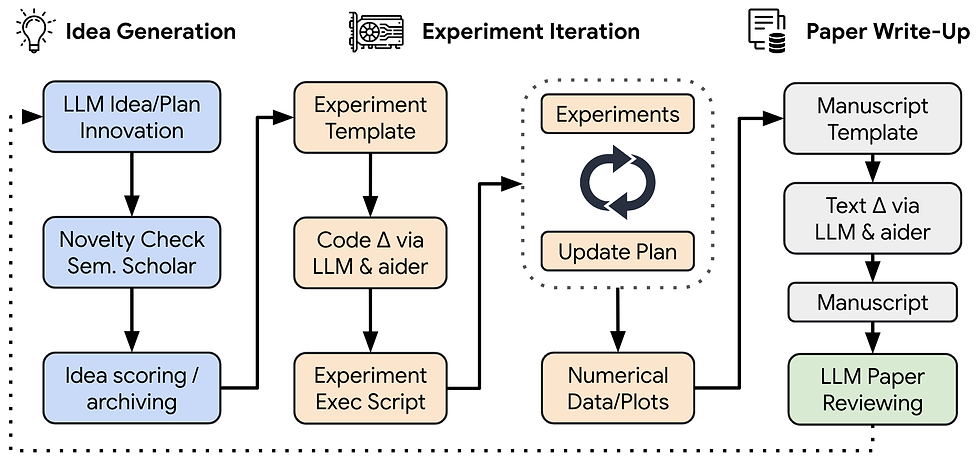
Historically, artificial intelligence in science was primarily utilized for data analysis and pattern recognition. Today, AI is evolving from a passive analytical tool into an active, autonomous agent capable of driving the scientific method itself. These AI agents can formulate hypotheses, design experiments, execute them through robotic interfaces, and analyze the results to refine their understanding [1].
A prime example of this leap is Google DeepMind's Graph Networks for Materials Exploration (GNoME). In a groundbreaking achievement, GNoME discovered 2.2 million new crystals, including 380,000 stable materials that could potentially power future technologies such as advanced batteries and superconductors [2]. This level of discovery, which would take human researchers centuries to achieve, demonstrates the unprecedented scale at which AI can operate.
Furthermore, the concept of the "AI Co-Scientist" is becoming a reality. Multi-agent AI systems are being developed to act as virtual scientific collaborators, helping human scientists generate novel research proposals and navigate vast oceans of scientific literature [3].
The Emergence of Self-Driving Labs
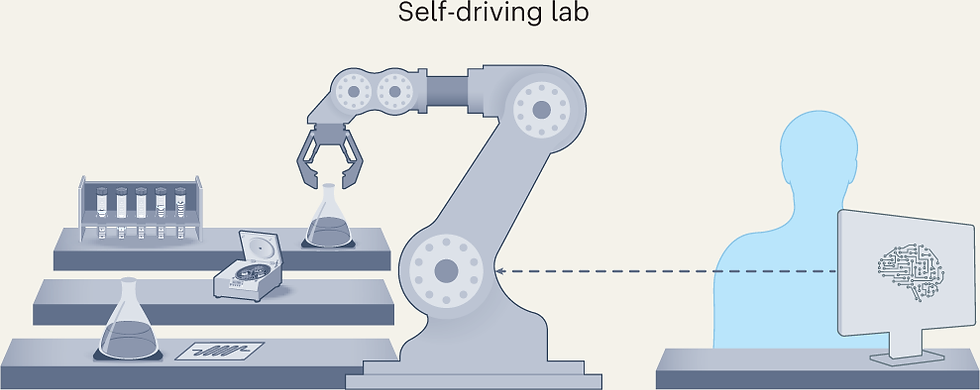
The physical manifestation of autonomous AI in science is the "Self-Driving Lab" (SDL). SDLs combine artificial intelligence with automated robotic hardware to accelerate the discovery process. In these environments, the AI acts as the "brain," making real-time decisions about which experiments to run next based on the outcomes of previous ones, while robotic arms and automated fluid handlers act as the "hands" [4].
"Self-driving labs bring AI capabilities to the physical world, using machine learning and robotics to automate and dramatically accelerate the scientific discovery process." [5]
These autonomous laboratories operate 24/7, significantly reducing the time required to develop new drugs, chemicals, and materials. By removing the bottleneck of manual human execution, self-driving labs allow scientists to focus on high-level strategy and creative problem-solving.
Collaborative Automation: Humans and Robots Working Together
While fully autonomous labs represent the cutting edge of high-throughput research, the broader trend in automation is shifting toward collaborative environments. Traditional industrial robots were massive, dangerous machines confined to safety cages, designed to perform a single task repeatedly. In contrast, the modern approach emphasizes Human-Robot Collaboration (HRC) [6].
Collaborative robots, or "cobots," are designed to share workspaces safely with humans. They are equipped with advanced sensors, force limiters, and computer vision to detect human presence and avoid collisions. This shift allows for a more flexible and dynamic workflow where humans and robots complement each other's strengths.

In engineering and manufacturing, cobots handle ergonomically challenging, dangerous, or highly repetitive tasks, while human workers manage complex problem-solving, quality control, and tasks requiring fine dexterity. This symbiotic relationship not only improves efficiency but also enhances workplace safety and job satisfaction by augmenting human capabilities rather than simply replacing them [7].
Humanoid Robots: The Ultimate Collaborative Interface
The most ambitious frontier in collaborative automation is the development of humanoid robots. For years, robots were designed with form following function—robotic arms for assembly, wheeled bases for logistics. However, the human world—our laboratories, factories, and tools—is designed for the human form. Humanoid robots offer the ultimate flexibility, capable of navigating environments and using tools without requiring expensive infrastructure modifications [8].
Recent advancements in AI, battery technology, and actuators have brought humanoid robots out of the realm of science fiction and into commercial reality. Several leading platforms are currently pushing the boundaries of what is possible:
Robot Model | Developer | Key Features | Target Applications |
Optimus Gen 2 | Tesla | 11 Degrees of Freedom (DoF) per hand, tactile sensing, integrated with Tesla's FSD neural networks for learning. | Manufacturing, logistics, and eventually domestic assistance. |
Atlas (Electric) | Boston Dynamics | Fully electric, 56 DoF, full rotational joints, unmatched dynamic mobility and balance. | Heavy industry, hazardous environments, complex manipulation. |
Figure 02 | Figure AI | OpenAI-powered speech-to-speech reasoning, advanced vision systems, high payload capacity. | Automotive manufacturing, warehousing, general-purpose labor. |


In the context of science and engineering, humanoid robots hold immense promise. A humanoid robot could seamlessly transition from pipetting chemicals at a lab bench to operating a centrifuge, and then walk to a different room to analyze a sample under a microscope. By embodying AI agents in humanoid forms, we create versatile assistants capable of executing complex, multi-step experimental protocols in environments built for humans.
Multiplying Innovative Capacity
The true revolution lies in the synergy between autonomous AI agents and advanced robotics (both collaborative arms and humanoids). When an AI agent capable of autonomous reasoning is paired with a robotic system capable of physical execution, the innovative capacity of a research team is multiplied exponentially.
Accelerated Hypothesis Testing: AI agents can generate thousands of hypotheses and immediately task robotic systems to test them. This rapid iteration cycle drastically reduces the time from concept to discovery.
Unbiased Exploration: Human researchers inherently carry cognitive biases that influence experiment design. AI agents can explore unconventional parameter spaces, leading to serendipitous discoveries that humans might overlook.
Reproducibility and Precision: Robotic execution ensures that experiments are conducted with exact precision every time, solving the reproducibility crisis that plagues many scientific fields.
Continuous Innovation: Unlike human researchers who require rest, an AI-driven robotic lab can operate continuously, effectively turning a single laboratory into a 24/7 discovery engine.
Challenges and Future Outlook
Despite the rapid progress, several challenges remain before this vision is fully realized.
Technologically, while AI models excel at digital tasks, translating reasoning into complex physical actions (Moravec's paradox) remains difficult. Humanoid robots still struggle with the fine motor skills and tactile feedback required for delicate scientific procedures. Furthermore, the energy efficiency and battery life of untethered robots need significant improvement for continuous operation [9].
From a systemic perspective, integrating AI agents into existing laboratory infrastructures requires standardized communication protocols and robust safety frameworks. There is also the challenge of "hallucinations" in AI models; an autonomous agent must have rigorous validation mechanisms to ensure it does not execute dangerous or nonsensical physical experiments.
Finally, the workforce implications are profound. The role of the scientist and engineer will shift from manual experimentation to system architecture, AI supervision, and high-level data interpretation. Education systems must adapt to train the next generation of researchers to collaborate effectively with AI and robotic counterparts.
The integration of humanoid robots, collaborative automation, and autonomous AI agents marks a pivotal moment in the history of science and engineering. We are moving beyond automation as a mere tool for efficiency, entering an era where AI and robots act as active collaborators in the pursuit of knowledge. By autonomously researching, experimenting, and discovering, these systems will multiply our innovative capacity, enabling us to solve some of the world's most complex challenges—from discovering sustainable materials to developing life-saving therapeutics—at an unprecedented pace. The future of innovation is not human versus machine, but human and machine, working together in a shared, collaborative environment.
References
[1] Boiko, D. A., MacKnight, R., & Gomes, G. (2023). Autonomous Agents for Scientific Discovery. arXiv preprint arXiv:2510.09901.
[2] Google DeepMind. (2023). Millions of new materials discovered with deep learning. Retrieved from DeepMind Blog.
[3] Google Research. (2025). Accelerating scientific breakthroughs with an AI co-scientist. Retrieved from Google Research Blog.
[4] Abolhasani, M., & Kumacheva, E. (2023). The rise of self-driving labs in chemical and materials sciences.Nature.
[5] Institute for Progress. (2025). Scaling Materials Discovery with Self-Driving Labs.
[6] International Federation of Robotics. (2024). Collaborative Robots - How Robots Work alongside Humans.
[7] Association for Advancing Automation. (2024). The Impact of Humanoid Robots on the Production Workforce.
[8] McKinsey & Company. (2025). Humanoid robots: Crossing the chasm from concept to commercial reality.
[9] StandardBots. (2026). The most advanced robots in 2026.
Comments