


Turning Collisions into Knowledge: Inside the Particle Physics Research at the University of Geneva


Geneva’s place in the particle-physics story
Particle physics asks a precise question: what are the smallest known constituents of matter, and which laws govern their interactions? In Geneva, that question is pursued through a close scientific connection between the University of Geneva (UNIGE) and CERN, the European laboratory for particle physics. The university’s Department of Nuclear and Corpuscular Physics (DPNC) works across collider physics, neutrino experiments, astroparticle physics and medical physics, with CERN’s Large Hadron Collider (LHC) at the centre of its collider programme [1].
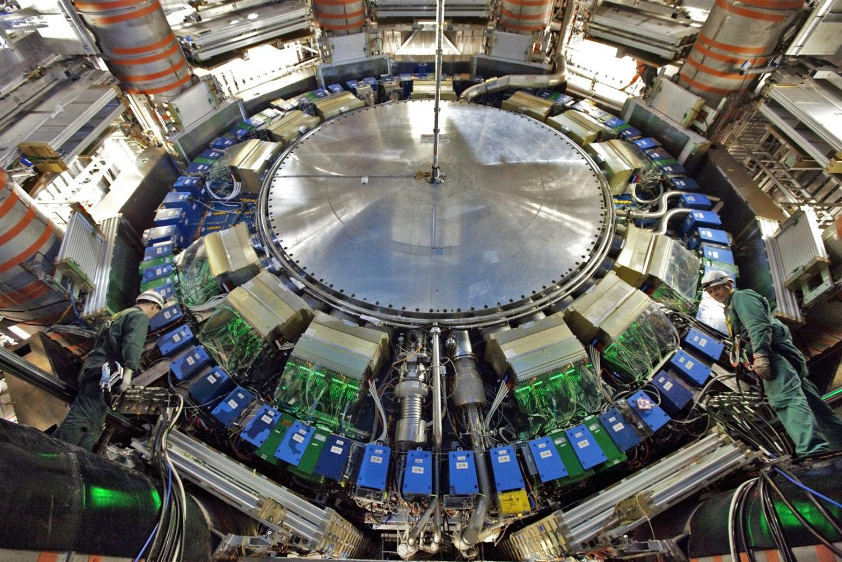
UNIGE’s contribution is not limited to observing a result announced by a large international collaboration. Its researchers design detector hardware, build electronics, develop reconstruction software, coordinate analyses and interpret data. These roles are essential because a discovery depends on the full chain: a collision must be recorded, a signal must be separated from background events, and the result must survive detailed statistical and theoretical checks.
From the Higgs boson to precision tests
The LHC’s 2012 discovery of the Higgs boson confirmed the existence of the Higgs field, a field associated with the mechanism that gives mass to elementary particles [2]. ATLAS and CMS found the particle by studying the short-lived products of proton collisions. The signal was rare: CERN notes that a Higgs boson appears in roughly one out of a billion LHC collisions, so the evidence had to be extracted from a very large data set [2].
The University of Geneva’s ATLAS group has contributed to detector construction, including tracking and readout systems, and to analyses of the Higgs boson and other Standard Model processes [1]. This combination of instrumentation and analysis gives the group a role at both ends of the experiment: making the detector perform reliably and using its measurements to test physical models.
A direct look at the top quark–Higgs interaction
One example shows how the Geneva group helped move from discovery to a sharper test. In 2018, ATLAS reported the first observation of Higgs bosons produced together with a pair of top quarks, a process known as ttH. Stefan Gadatsch, from the ATLAS group led by Tobias Golling at the DPNC, was one of the analysis leaders and an editor of the associated paper [3].
The result gave physicists a direct measurement of the interaction between the Higgs boson and the top quark. That interaction is especially informative because the top quark is the heaviest known elementary particle. The combined ATLAS data from 2015–2017 reached a significance of 6.3 standard deviations, above the five-standard-deviation convention used for a discovery claim [3]. The measured production rate agreed with the Standard Model prediction, strengthening the case that the top quark receives its mass through interaction with the Higgs field.
This kind of measurement illustrates the changing character of the LHC programme. Once a new particle has been found, researchers must map its properties: how it is produced, how it decays and how strongly it interacts with other particles. Each precise measurement can confirm the theory or reveal a small discrepancy that points toward new physics.
FASER and the first collider-produced neutrinos
Geneva’s research also reaches into a newer experimental direction: neutrinos produced directly in a particle collider. The FASER experiment at CERN detected neutrinos from LHC collisions for the first time, with results announced in March 2023 [4]. These neutrinos are exceptionally energetic and resemble, in energy, particles created when cosmic rays strike Earth’s atmosphere.
UNIGE groups made major contributions to FASER. Teams associated with Giuseppe Iacobucci and Anna Sfyrla, together with DPNC technical staff, helped build the part of the detector that measures charged particles. They also developed readout and trigger electronics and software, then helped install, commission and operate the experiment [4].

FASER is compact compared with ATLAS: it weighs about one tonne and fits inside a side tunnel of the LHC, while ATLAS is more than 20 metres high and weighs about 7,000 tonnes [4]. Its physics goals extend beyond neutrinos. The detector also searches for particles that could help explain dark matter, which has not yet been directly observed.
The work behind a detector result
A modern particle-physics result is the outcome of many kinds of expertise. Mechanical structures must be aligned. Silicon sensors must withstand radiation. Electronics must distinguish a real signal from noise at high speed. Software must reconstruct the paths and energies of particles, while machine-learning methods can help classify complex event patterns. The UNIGE collider programme lists work on silicon tracking for the High-Luminosity LHC, trigger systems, particle-flow reconstruction, b-jet identification and machine learning [1].
The long-term value of this work is scientific and technical. Detector development requires precision engineering, cryogenics, radiation-tolerant electronics, high-speed computing and statistical analysis. These capabilities can move between fundamental research, medical imaging and other applications. A UNIGE video featuring Professor Domenico Della Volpe describes how particle-physics expertise can support medical-physics projects, including imaging technology intended to reduce the invasiveness of some procedures [5].
A research community linked to CERN
Geography helps explain Geneva’s role. UNIGE is close to CERN, and the DPNC describes that proximity and close connection as central to its research programme [1]. Students and researchers can work with large international teams while remaining part of a university environment that trains new physicists, engineers and data specialists.
The collaboration is also intellectually broad. Alongside ATLAS, UNIGE researchers work on neutrino programmes such as T2K and Hyper-Kamiokande, astroparticle experiments such as IceCube and CTA, and space missions including AMS, POLAR and DAMPE [1]. These projects approach open questions from different directions: the identity of dark matter, the small masses of neutrinos, the imbalance between matter and antimatter, and the possible limits of the Standard Model.
Closing Thoughts
Geneva’s contribution to particle physics is best understood as sustained participation across the entire research process. UNIGE scientists have helped build the instruments, develop the computing methods and lead analyses that convert rare events into tested statements about nature. The university’s connection with CERN gives that work a local base and an international reach.
The Higgs programme shows how a discovery becomes a programme of precision measurements. FASER shows how a compact detector can open a new window on collider-produced neutrinos and possible hidden particles. Together, these examples show a research culture that combines careful engineering, statistical discipline and curiosity about unanswered questions.
What does this actually mean?
It means that the University of Geneva is not simply near CERN; it is an active partner in the experiments that define modern particle physics. Its researchers contribute to hardware, software, operations and scientific interpretation. When ATLAS measures a rare Higgs process or FASER identifies neutrino interactions, the result reflects work distributed across institutions, with UNIGE teams occupying several important links in that chain.
Why does this matter?
This is important because reliable knowledge about the basic structure of matter depends on precision and cooperation. A single detector component, calibration method or analysis can influence the confidence of a major result. The same skills also support new technologies, medical research and advanced training. Geneva therefore contributes not only to answers about particles, but also to the people, instruments and methods needed for the next questions.
References
University of Geneva, “Department of Nuclear and Corpuscular Physics” and “Collider Physics,” https://www.unige.ch/dpnc/en/
CERN, “The Higgs boson,” https://home.cern/science/physics/higgs-boson/
University of Geneva, “ATLAS produces the first measurement of Higgs production in association with top quarks,” 5 June 2018, https://www.unige.ch/dpnc/en/news/all-news/atlas-produces-first-measurement-higgs-production-association-top-quarks/
University of Geneva, “The FASER experiment at the CERN LHC detects for the first time neutrinos produced at a particle collider,” 19 March 2023, https://www.unige.ch/sciences/physique/en/news/faser-experiment-cern-lhc-detects-first-time-neutrinos-produced-particle-collider
University of Geneva / CERN, “From Particle Physics to Innovation: Detector Technologies,” video, https://www.youtube.com/watch?v=VyAler3eqgw
ATLAS Collaboration, “Detector & Technology,” reference image source, https://atlas.cern/
Comments