


The Evolving Threat of AI Voice Cloning Phone Scams and Android's Real-Time Defense


Among the most insidious new threats are phone scams that utilize Artificial Intelligence (AI) to clone voices and spoof phone numbers, making it incredibly difficult for individuals to distinguish legitimate calls from fraudulent ones. These sophisticated attacks often impersonate trusted contacts, such as family members or financial institutions, to exploit victims for monetary gain. In response to this escalating threat, Google has integrated real-time alert systems into Android, designed to identify suspicious patterns of identity impersonation during active calls, offering a crucial layer of defense against these evolving forms of cybercrime.
The Growing Sophistication of Impersonation Scams
Impersonation fraud has become a significant contributor to global financial losses, with reports indicating billions of dollars lost annually [1]. The Federal Trade Commission (FTC) has highlighted impersonation scams as one of the top reported frauds, with substantial financial impacts on victims [1]. The traditional reliance on caller ID to verify the identity of a caller is no longer sufficient, as scammers have developed advanced methods to circumvent these safeguards.
Scammers now combine two powerful tactics to execute their schemes:
Phone Number Spoofing: Malicious actors route calls through internet-based software to manipulate caller ID, making it appear as though the call originates from a familiar contact [1]. This tactic bypasses the natural caution many individuals exercise when receiving calls from unknown numbers.
AI Deepfake Technology: Utilizing readily available AI tools, scammers can generate highly realistic voice clones that mimic the tone and speech patterns of specific individuals. Experts note that AI audio deepfakes have become so convincing that most people struggle to differentiate them from genuine human voices [1]. This technology allows scammers to impersonate family members, authority figures, or employers, creating a compelling illusion of legitimacy.
Imagine receiving a call where the caller ID displays your mother's name, and upon answering, you hear her exact voice, tone, and mannerisms. The caller then fabricates an urgent emergency, demanding immediate financial assistance. This scenario, once the stuff of science fiction, is now a stark reality, highlighting the critical need for advanced protective measures.
Android's Real-Time Fake Call Detection
In a significant advancement for mobile security, Android has introduced a fake call detection feature designed to protect users from these sophisticated impersonation scams. This industry-first protection can detect and flag suspected spoofed calls in real-time, particularly when both the caller and recipient are using the Phone by Google app [1]. This builds upon previous initiatives, such as verified financial calls, which alert users if a scammer attempts to impersonate a financial institution [1].
The fake call detection feature operates seamlessly in the background and is enabled by default.
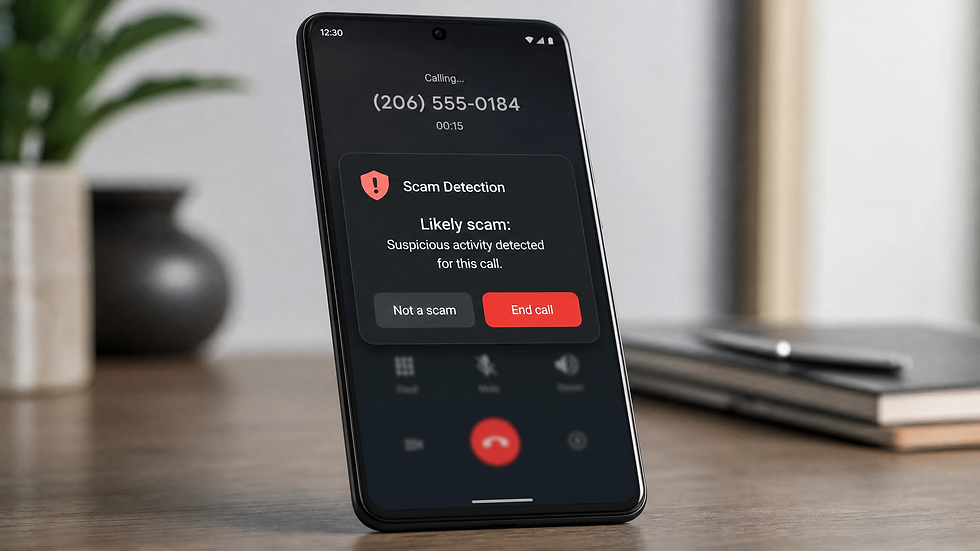
It functions through a "digital handshake" mechanism between devices. When a contact calls, and both parties use Phone by Google, the caller's device sends a silent, real-time confirmation signal to the recipient's device, verifying the call's legitimacy. This digital handshake is secured using end-to-end encrypted Rich Communication Services (RCS) technology, ensuring privacy [1].
If a scammer attempts to impersonate a contact, this crucial confirmation signal will be absent. The recipient's device will immediately detect this anomaly and send an authenticated RCS ping to the supposed caller's actual device for verification. If the real device indicates it is not currently making a call, a warning will appear on the recipient's screen, advising them to terminate the call immediately. This proactive alert empowers users to avoid falling victim to deepfake impersonation and call spoofing in real-time [1]. Users have the option to disable this feature within the Phone by Google app settings.
Availability and Broader Impact
Google is progressively rolling out fake call detection globally to Android 12+ devices, commencing with Pixel devices. While Phone by Google is the default dialer for many Android devices, users with alternative phone apps can install Phone by Google from the Play Store and set it as their default to benefit from this protection [1].
Google's commitment extends beyond proprietary solutions. By building this feature on Rich Communication Services (RCS), an open standard, Google aims to encourage other app developers and device manufacturers to adopt this technology, thereby raising the industry standard for scam protection and safeguarding a broader user base [1].
Google's Ongoing Fight Against Scams
Fake call detection is the latest addition to Google's comprehensive strategy to combat impersonation and scams. The company has a long-standing history of leadership in this domain, implementing various protective measures across its ecosystem:
AI-powered Scam Detection in Google Messages: This feature automatically protects Android users from malicious scam texts. Additionally, Pixel and Samsung users can enable Scam Detection within the Phone by Google app to flag suspicious calls [1].
Brand Indicators for Message Identification (BIMI) in Gmail: Google supports BIMI, which helps verify senders and enhance trust in email communications [1].
RCS for Business: This initiative ensures that businesses contacting users via RCS are verified, providing clarity and reducing the risk of impersonation [1].
STIR/SHAKEN Authentication: Google has championed and integrated STIR/SHAKEN authentication at the network level in multiple countries, a technology designed to combat illegal robocalls and call spoofing [1].
These continuous efforts underscore Google's dedication to evolving its protections as scammers refine their tactics. The integration of advanced AI and real-time detection mechanisms represents a critical step in staying ahead of cybercriminals and safeguarding users in an increasingly complex digital landscape.
The proliferation of AI-powered voice cloning and sophisticated call spoofing techniques has ushered in a new era of telephone scams, posing significant challenges to personal and financial security. However, the proactive response from platforms like Android, with its real-time fake call detection system, offers a vital defense. By leveraging on-device AI and secure communication protocols, Android empowers users with the tools to identify and mitigate these threats, reinforcing the importance of continuous innovation in cybersecurity. As the battle against cybercrime intensifies, collaborative efforts between technology providers, users, and regulatory bodies will be paramount in fostering a safer digital environment.
References
[1] Google. (2026, June 2). How Android helps keep you safe from impersonation scams with fake call detection. Retrieved from https://blog.google/security/android-fake-call-detection/
[2] Markovic, S. (2024, November 14). Google launches on-device AI to alert Android users of scam calls in real-time. Help Net Security. Retrieved from https://www.helpnetsecurity.com/2024/11/14/android-scam-detection/
[3] Whitwam, R. (2026, June 2). Android phones will soon be able to detect spoofed calls and impersonation scams. Ars Technica. Retrieved from https://arstechnica.com/gadgets/2026/06/google-announces-deepfake-call-detection-for-android-new-airdrop-device-support/
Comments