


Space Robotics and Biomedicine: Artemis II Puts Lunar Life-Support Systems to the Test

Artemis II is no longer an upcoming flight: NASA’s first crewed Orion mission around the Moon launched on 1 April 2026 and returned safely on 10 April. Its most consequential test was also its most basic one: could a compact spacecraft keep four people alive, healthy, and able to work far beyond low Earth orbit?

A flight test with people aboard
NASA astronauts Reid Wiseman, Victor Glover, and Christina Koch, together with Canadian Space Agency (CSA) astronaut Jeremy Hansen, flew Orion—named Integrity—on a nearly 10-day lunar flyby. The crew traveled 695,081 miles in total and reached a maximum distance of 252,756 miles from Earth before splashing down in the Pacific Ocean. Artemis II did not land on the Moon; it tested the crewed spacecraft, its operations, and the systems needed for later lunar missions. [1]
The distinction is important. Before Artemis II, Orion’s life-support functions had not been tested with astronauts aboard in deep space. In flight, crew and ground teams checked spacecraft systems, carried out manual piloting demonstrations, exercised, practiced procedures, and evaluated equipment under actual mission conditions. NASA reported after splashdown that the crew had tested Orion’s life-support systems and that the spacecraft sustained them during the flight. Detailed engineering review continued after recovery. [1][2]
Life support: small cabin, demanding job
A crewed spacecraft must regulate cabin conditions and supply what people need while allowing the crew to handle equipment, meals, hygiene, exercise, sleep, and emergencies. In Orion, those demands are compressed into a cabin NASA describes as roughly the size of two minivans. NASA’s preflight description listed potable water and oxygen and nitrogen among the essential supplies delivered by the European Service Module, alongside power, propulsion, and temperature control. [3][4]
That arrangement should not be confused with the International Space Station’s more regenerative environmental-control system. The ISS has equipment that recovers wastewater and cabin humidity, filters air, and generates oxygen. Orion’s short test flight instead relied on mission-specific consumables and systems. NASA’s description of Orion’s waste equipment notes that urine was vented overboard and solid waste was collected for return, rather than processed through the station’s full water-recycling loop. The two vehicles share engineering lessons, but they are not identical life-support platforms. [3][5]
Artemis II also demonstrated why a successful mission is not the same as a finished design. NASA’s initial postflight assessment said teams were investigating a urine-vent-line issue and would identify its cause and corrective action for Artemis III. A crew returned safely, yet a small subsystem anomaly still became valuable evidence for the next vehicle configuration. [2]
Biomedicine travels with the crew
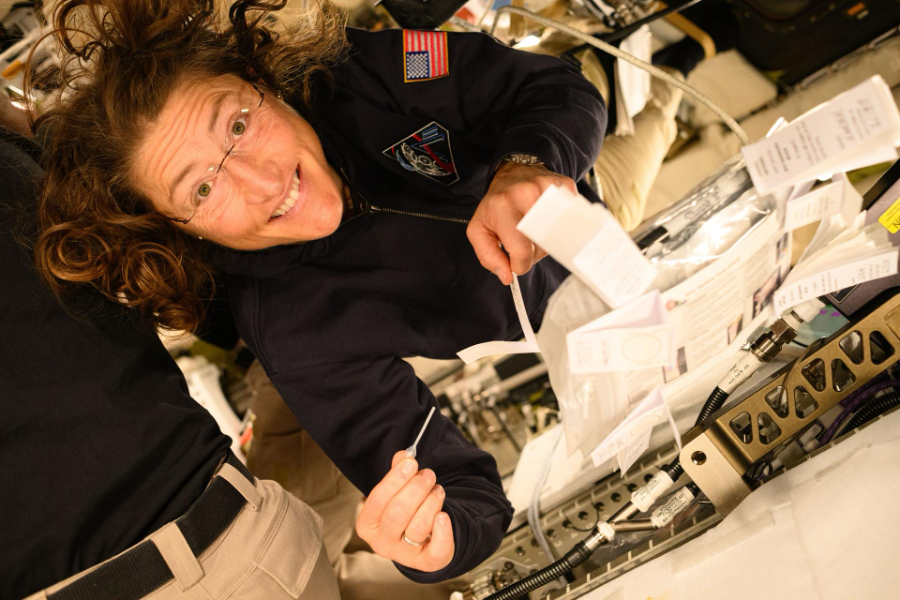
The crew were also research participants. The CSA describes five Artemis II health investigations that collected information about how deep-space travel affects the body and performance:
ARCHeR used wearable wrist devices to monitor sleep and activity, alongside measures related to stress, cognition, and teamwork.
Immune Biomarkers used saliva and before-and-after blood samples to study immune changes and other biological signals.
AVATAR sent organ-on-a-chip devices containing astronaut-derived cells to explore how microgravity and space radiation affect tissue responses.
Standard Measures gathered physiological, functional, and behavioral observations before, during, and after flight.
Radiation monitoring used cabin sensors and personal dosimeters to characterize exposure beyond Earth’s protective magnetic environment. [6]
The methods were selected for a mission where refrigeration, laboratory space, and crew time are limited. Dried saliva samples could be stored in small booklets; wrist monitors gathered data with little crew intervention; and miniature tissue chips let researchers examine cellular responses without an invasive procedure. The mission’s short duration does not answer every question about a months-long lunar stay, but it supplies rare human data from beyond low Earth orbit.

Health protection also includes the return to gravity. On flight day eight, all four astronauts evaluated an orthostatic-intolerance garment designed to help maintain blood pressure and circulation when moving from microgravity back to Earth. They also exercised on Orion’s compact flywheel device. Such tests connect spacecraft engineering with medical procedures: the vehicle must support a crew not only in transit but through re-entry, recovery, and the first hours after landing. [7]
International contributions—and where robotics fits
Artemis II was an international undertaking, but its partners contributed different pieces rather than one shared “life-support experiment.” NASA led Orion and the mission. ESA’s European Service Module supplied major spacecraft functions, including propulsion, electrical power, water, oxygen, nitrogen, and thermal control. Canada flew astronaut Jeremy Hansen and published the research account of the crew-health program. Germany, South Korea, Saudi Arabia, and Argentina also contributed CubeSats or radiation-related investigations launched as part of the mission’s broader science effort. [1][4][6]
The robotics connection needs a similarly clear boundary. Artemis II was not a robotic-arm demonstration, and no robotic manipulator performed the crew’s life-support tests. The crew manually piloted Orion during proximity-operations demonstrations, gathering handling and navigation data relevant to future rendezvous and docking. Those capabilities will matter as later Artemis flights connect crewed spacecraft with lunar systems. Robotic manipulators and autonomous operations—developed and used across the wider space program, including on the ISS—are complementary tools, not proof that a robot operated Orion’s life-support equipment on this flight. [1][2]
The useful bridge between robotics and biomedicine is operational: long missions will depend on crews, sensors, automated environmental systems, and robotic assets working together while communication with Earth is delayed. Artemis II supplied a crewed test of part of that chain. It did not yet validate a self-sufficient lunar habitat, long-duration medical care, or every future robotic interface.
Closing Thoughts
Artemis II’s value lies in the evidence gathered while people—not just instruments—used Orion far from Earth. The mission showed that the international hardware and operations could carry a crew around the Moon and bring them home, while also exposing issues that engineers can address before the next flight. That combination of demonstrated performance and specific lessons is a stronger basis for progress than a claim of perfection.
What is the true implication of this?
The central implication is that a return to the lunar surface depends on integrated human systems. Oxygen, water, waste handling, radiation awareness, sleep, exercise, medical monitoring, manual control, and recovery procedures all have to function together. Artemis II provided an early crewed data point for that system; it did not remove the need for longer-duration tests and careful follow-up.
What makes this significant?
Artemis II converted design assumptions into flight experience beyond Earth orbit. NASA, ESA, CSA, and other partners contributed distinct hardware, people, or research, while the crew tested Orion under real conditions. That shared evidence can guide safer spacecraft, better health countermeasures, and future combinations of human crews, automation, and robotics on the route to sustained lunar exploration.
Video references
References
1 NASA, “NASA Welcomes Record-Setting Artemis II Moonfarers Back to Earth”, 10 April 2026 (updated 7 May 2026).
2 NASA, “NASA on Track for Future Missions with Initial Artemis II Assessments”, 20 April 2026.
3 NASA, “Life Encapsulated: Inside NASA’s Orion for Artemis II Moon Mission”, 29 September 2023.
4 European Space Agency, “Artemis II”.
6 Canadian Space Agency, “Artemis II: Scientific research during the mission”, 1 May 2026.
7 NASA, “Artemis II Flight Day 8: Crew Conducts Key Tests on Return to Earth”, 8 April 2026.
Comments