


Smart-Home Automation and Control: When Appliances Begin to See, Sense, and Act

The smart home is moving beyond remote control. A connected appliance no longer needs to wait for a button press or a voice command; it can observe conditions, interpret context, choose a response, and coordinate with other devices. Cameras, microphones, temperature probes, load cells, air-quality monitors, proximity sensors, and software models are becoming part of the domestic control layer.
The result is a new class of household automation. A refrigerator can maintain an inventory, an oven can adjust a cooking program, a washing machine can infer fabric conditions, and a cleaning robot can distinguish obstacles from dirt. In personal hygiene, pressure sensing, motion tracking, water-flow measurement, and bathroom safety systems can offer guidance or early alerts. These functions are useful, but they also raise a central question: how much observation should a home require before it can act on a person’s behalf?

From connected devices to perception-driven systems
Traditional home automation follows a simple rule: if a sensor detects a threshold, then an actuator performs a predefined action. AI-enabled automation adds interpretation. A camera may identify a food category rather than merely detect movement. A washing machine may combine weight, water absorption, drum behavior, and a selected cycle to estimate how a load should be handled. A domestic robot may use depth sensing and visual recognition to build a map, identify a chair as an obstacle, and return to its dock when its battery is low.
This creates a four-stage loop:
Stage | What the system does | Typical technologies |
Sensing | Captures a state or event | Cameras, microphones, temperature, humidity, weight, motion, pressure, air-quality and water sensors |
Interpretation | Converts signals into meaning | Computer vision, speech recognition, anomaly detection, classification and multimodal AI |
Decision | Selects a response under constraints | Rules, learned models, schedules, energy policies and user preferences |
Action and feedback | Operates equipment and checks the result | Motors, valves, heating elements, locks, notifications and a second sensor reading |
The feedback stage is essential. If a robot is told to clean a room but cannot verify whether a spill has disappeared, the system is only partially autonomous. Reliable domestic assistance requires the machine to notice uncertainty, ask for help when appropriate, and fail safely rather than confidently making the wrong decision.
The kitchen becomes an information system
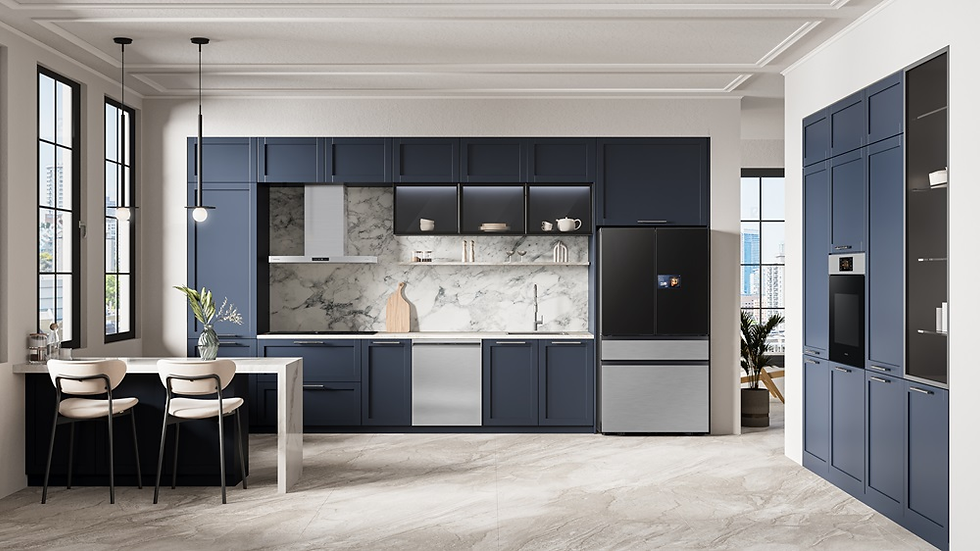
Refrigerators provide a clear example because their contents change constantly. Samsung states that its enhanced AI Vision Inside feature can recognize 37 types of fresh food and can identify selected processed foods, which users may save with names for later recognition. The company also presents recipe suggestions, meal planning, appliance control, and energy monitoring through the refrigerator interface 1.
Such functions can reduce the friction between inventory and action. A system might notice that vegetables are available, suggest a recipe, add missing ingredients to a shopping list, and preheat an oven at the right moment. Yet image recognition is not the same as perfect knowledge. Packaging can obscure a product, lighting can change its appearance, and a camera may not know whether a container is full, nearly empty, expired, or intended for a particular person. Human confirmation remains valuable for allergens, food safety, and shared households.
Ovens are also gaining context-aware features. A camera can help identify a dish, while temperature probes and cooking models estimate doneness. The most useful design is not one that removes every decision from the cook; it is one that handles repetitive monitoring and makes its assumptions visible. A user should be able to see which sensor reading caused a change in temperature or cooking time.
Laundry and cleaning: automation under uncertainty
Laundry is difficult to automate because fabrics vary, labels are incomplete, and a single load may contain conflicting requirements. Sensors can measure load size, water level, motor resistance, temperature, and cycle behavior. AI can use these signals to recommend a program or detect an unusual pattern that may indicate imbalance or a maintenance issue. The practical benefit is not a magical machine that understands every garment, but a system that reduces avoidable mistakes and warns before a small problem becomes a breakdown.
Cleaning robots face a more demanding environment. Floors contain cables, toys, shoes, pets, people, reflective surfaces, and liquids. Computer vision and depth sensing help the robot classify objects and plan routes. A premium cleaner may vacuum, mop, empty its own dustbin, wash its pad, and report when it cannot reach a blocked area. A household robot with arms would need a much richer form of perception: it would have to locate objects, estimate how they can be grasped, understand where they belong, and recognize whether an action succeeded.
LG’s proposed smart-home AI agent illustrates this wider ambition. The company describes a mobile home hub that combines cameras, speakers, sensors, image recognition, voice recognition, and natural-language processing. LG says the agent can gather temperature, humidity, and indoor-air-quality data, connect with appliances and household IoT devices, and switch off unused equipment through a smart outlet 2. These are promising capabilities, but a product announcement should not be confused with universal availability or proof that every complex domestic task is solved.
Personal hygiene: assistance, feedback, and dignity
Personal hygiene is a particularly sensitive area because the technology interacts with the body and with intimate routines. The most mature products generally provide feedback rather than autonomous physical intervention. Oral-B’s iO electric toothbrushes, for example, use a smart pressure sensor that signals whether brushing pressure is too high, too low, or appropriate 3. This is a narrow but useful form of control: the device helps a person adjust technique without claiming to diagnose disease.
Bathroom systems can also support accessibility and independent living. Motion sensors, water-temperature monitoring, leak detection, lighting automation, and fall-detection systems can reduce risk. A toilet or shower could recognize a user’s preferences, adjust height or water temperature, and alert a caregiver when a routine changes sharply. These systems should be designed around consent, local processing where possible, accessible overrides, and clear escalation rules.
The boundary between wellness assistance and medical care must remain explicit. A sensor may identify an unusual pattern, but that does not establish a diagnosis. Any product that analyzes bodily data should explain what it measures, how long it stores the information, who can access it, and what happens when the system is wrong. In intimate spaces, dignity is not an optional interface feature; it is a core safety requirement.
Control architectures that make automation trustworthy
There are three practical control models. In a local model, cameras and sensor data are processed inside the appliance or home hub. This can reduce latency and limit data leaving the home, although local hardware may constrain model complexity. In a cloud-assisted model, the appliance sends data to remote servers for heavier analysis and receives recommendations or commands. This can improve capabilities but increases dependence on connectivity, vendor policies, and account security. A hybrid model keeps routine actions local while using remote services for selected tasks.
Design principle | Why it matters in a smart home |
Least data | Collect only what is needed for the declared function |
Explainable actions | Show why a device changed a setting or issued an alert |
Human override | Provide a physical control and an immediate stop function |
Safe degradation | Keep essential operation available when internet access fails |
Identity separation | Avoid confusing one family member’s preferences with another’s |
Secure updates | Patch vulnerabilities without disabling the appliance unexpectedly |
Data expiry | Delete images, voice recordings, and intimate measurements on a defined schedule |
Interoperability is equally important. A refrigerator, robot vacuum, lighting system, and energy meter should not each become an isolated island. Shared standards and well-documented interfaces can allow devices from different manufacturers to coordinate while preserving user choice. At the same time, centralization creates a larger target for attackers, so the home hub needs strong authentication, network segmentation, encrypted communication, and transparent permission settings.
A useful evaluation question is simple: what does the device know, what does it infer, and what can it physically do? A refrigerator may know that a package entered its field of view, infer that it is a food item, and suggest a recipe; it cannot necessarily verify freshness. A robot may know that an object blocks its path, infer that it is movable, and still lack the dexterity to relocate it. Good product communication keeps these distinctions visible.
AI-enabled appliances are changing the meaning of control in the home. The key advance is not a voice assistant that can turn on a lamp, but a coordinated system that combines perception, context, prediction, and feedback. Kitchen inventory, energy use, cleaning, laundry, accessibility, and hygiene can all benefit when machines handle repetitive monitoring and return meaningful choices to people.
The strongest designs will not promise a frictionless home at any cost. They will disclose uncertainty, protect intimate data, keep humans in control, and make assistance reversible. The smart home becomes genuinely useful when its intelligence is measured not by how much it can observe, but by how responsibly it turns observation into action.
References
Comments