


Raygun: The AI "Shrink Ray" Revolutionizing Protein Engineering at Duke University

The field of computational biology has reached a major breakthrough with the recent publication of a groundbreaking study from the Duke University School of Medicine. Researchers have unveiled Raygun, a generative artificial intelligence framework capable of redesigning proteins with unprecedented precision. Unlike previous models that focus on creating proteins from scratch, Raygun specializes in the modification of existing biological structures—allowing scientists to "shrink," "enlarge," or "rewrite" proteins while strictly preserving their original structure and function. This development, which has been under rigorous investigation since 2024, was recently detailed in the journal Nature [1].
The Breakthrough: Beyond De Novo Design
For decades, protein engineering has struggled with the "stability-function" trade-off. Traditional methods often found that modifying a protein's sequence to change its size or physical properties frequently resulted in a loss of its biological activity or a collapse of its three-dimensional fold. Raygun overcomes this challenge by utilizing protein language models (pLMs)—AI systems trained on millions of natural protein sequences to understand the underlying "grammar" of life.
"There is a language that governs how a protein's amino acid sequence gives rise to its shape and function, but scientists don’t fully understand that language. Protein language models act as a kind of translator, learning patterns from millions of protein sequences and linking those patterns to biological structure and function." — Rohit Singh, PhD, Assistant Professor at Duke University [2].

The Mechanism: How Raygun Operates
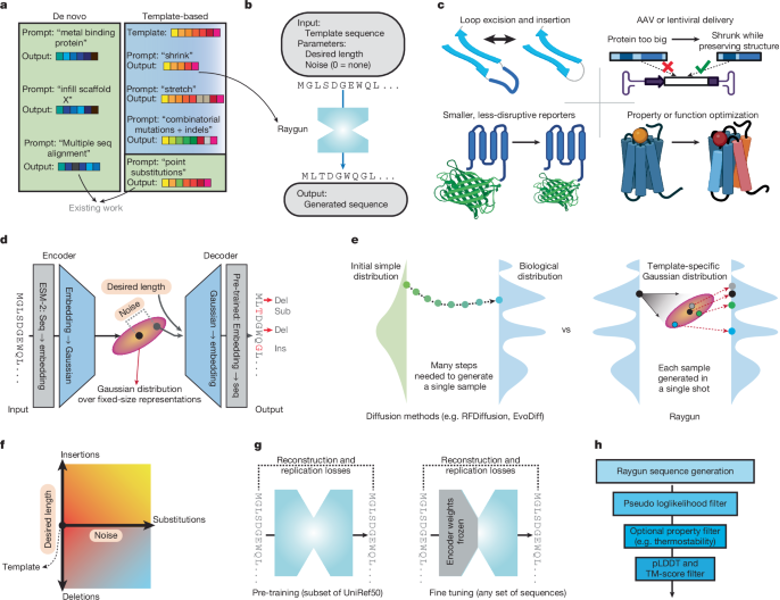
Raygun operates on a template-based design paradigm. Instead of generating a sequence in a vacuum, it takes a known protein as a starting point. The system converts the protein into a standardized mathematical representation that captures the essential structural features learned by the AI. This allows for a high degree of control over the output, governed primarily by two user-defined parameters:
Sequence Divergence: Controls the extent to which the amino acid sequence is allowed to change from the original.
Size Modification: Dictates whether the resulting protein should be shorter (miniaturized) or longer (magnified) than the template.
Feature | Traditional De Novo Design | Raygun Template-Based Design |
Starting Point | Random or target structure | Existing functional protein |
Control | Hard to maintain specific function | High preservation of function/structure |
Modification | Primarily sequence-based | Structural scaling (shrink/enlarge) |
Speed | Computationally expensive | Rapid iteration and validation |
Experimental Validation and Results
The Duke team, led by Rohit Singh, Scott Soderling, and Kapil Devkota, validated Raygun across several biological contexts. Their findings demonstrate that the AI can successfully navigate the complex rules of protein folding to produce variants that are functional in living cells.
Miniaturizing Fluorescent Proteins
The researchers applied Raygun to fluorescent proteins, such as eGFP and mCherry, which are vital tools for cellular imaging. The AI successfully created "shrunken" versions of these proteins that retained their ability to glow, proving that the structural "barrel" required for fluorescence could be maintained even with a reduced number of amino acids.
Engineering Growth Factors
One of the most promising applications involved the Epidermal Growth Factor (EGF), a protein involved in wound healing and cancer signaling. Raygun designed variants that maintained their ability to bind to the EGF receptor, despite significant changes to their sequence and size. This suggests that Raygun could be used to create more stable or potent versions of therapeutic proteins.
Implications for Targeted Medicine and Gene Therapy
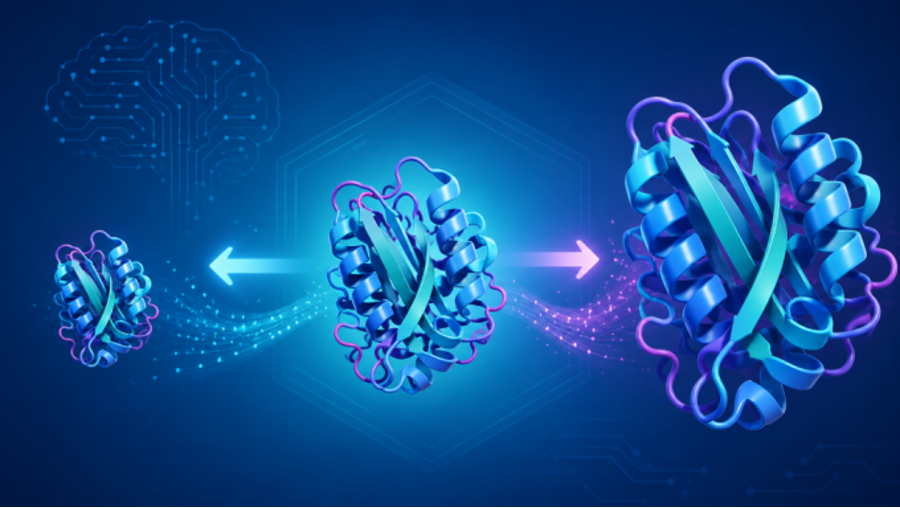
The ability to miniaturize proteins has profound implications for gene therapy. One of the primary bottlenecks in gene delivery is the limited payload capacity of viral vectors, such as Adeno-Associated Virus (AAV). Many therapeutic proteins are too large to fit inside these delivery vehicles. Raygun offers a solution by "shrinking" these proteins to a manageable size without sacrificing their therapeutic efficacy.
Furthermore, the framework allows for the augmentation of proteins to add new functionalities. For example, a protein could be redesigned to include a "hook" for a specific drug molecule or to be more resistant to degradation within the human body.

A New Era of Biological Engineering
The publication of Raygun's full details in 2026 marks a turning point in how scientists interact with the proteome. By treating proteins as a language that can be edited rather than a static code that must be rewritten, the Duke team has provided a tool that mirrors the efficiency of natural evolution but at a vastly accelerated pace.
The researchers have made the Raygun framework open-source, allowing the global scientific community to contribute to its refinement and apply it to a wide range of diseases, from rare genetic disorders to common cancers.
Raygun represents a fusion of deep learning and biochemistry that promises to redefine the boundaries of what is possible in medicine. As scientists continue to explore the vast space of protein configurations, tools like Raygun will be essential in ensuring that our designs remain grounded in the functional realities of biology.
References
Singh, R., Devkota, K., et al. (2026). "Miniaturizing and modifying natural proteins with Raygun." Nature, 631, 452–460. https://www.nature.com/articles/s41586-026-10842-8
Duke University School of Medicine. (2026). "Like a molecular 'shrink ray': AI tool redesigns proteins without sacrificing function." https://medschool.duke.edu/news/molecular-shrink-ray
Devkota, K., et al. (2024). "Miniaturizing, Modifying, and Augmenting Nature's Proteins." bioRxiv. https://www.biorxiv.org/content/10.1101/2024.08.13.607858v1
Reference Video:
Comments