


OpenAI Unveils GPT-Live: A New Era of Full-Duplex Voice Interaction

The realm of human-computer interaction has been fundamentally reshaped by OpenAI's newest release: GPT-Live. Launched on July 8, 2026, this new family of voice models represents a departure from the traditional, rigid back-and-forth of previous AI systems. By implementing a full-duplex architecture, OpenAI has enabled ChatGPT to listen and speak simultaneously, mirroring the natural flow of human conversation more closely than ever before.
The Evolution of Voice AI: From Stilted to Seamless
To appreciate the significance of GPT-Live, one must understand the limitations of previous approaches. Early voice systems were cascaded, meaning they chained three separate models: speech-to-text (STT) for transcription, a large language model (LLM) for reasoning, and text-to-speech (TTS) for output. This sequence introduced significant latency and often stripped away the emotional nuances of the user's voice.
The subsequent generation, exemplified by ChatGPT’s Advanced Voice Mode, improved upon this by processing audio natively within a single model. However, it remained half-duplex—a "walkie-talkie" style interaction where the model had to wait for a period of silence before it could respond. This often led to unnatural pauses or accidental interruptions caused by background noise.
Comparison of Voice Architectures
Feature | Cascaded Systems (Original Voice) | Turn-Based Models (Advanced Voice) | Full-Duplex (GPT-Live) |
Interaction Style | Sequential (STT -> LLM -> TTS) | Turn-based (Wait for silence) | Continuous (Listen & Speak) |
Latency | High (Several seconds) | Low (Milliseconds) | Ultra-low (Real-time) |
Interruptions | Not supported | Basic (Stops on voice detection) | Fluid (Reacts mid-sentence) |
Architecture | Multiple discrete models | Single multimodal model | Streaming full-duplex model |
Technical Deep Dive: The Full-Duplex Advantage
The core innovation of GPT-Live lies in its full-duplex architecture. Unlike previous models that processed audio in discrete chunks, GPT-Live treats audio as a continuous, bidirectional stream. This allows the model to make micro-decisions multiple times per second: deciding whether to continue speaking, pause for a user’s reaction, or acknowledge the user with back-channel signals like "mhmm" or "got it."
This architecture enables active listening. If a user pauses to gather their thoughts, GPT-Live can detect the difference between a finished thought and a momentary hesitation, remaining quiet until the user is ready to proceed. Conversely, if a user interrupts, the model can stop instantly and pivot its response based on the new input, maintaining the coherence of the dialogue without needing to restart the entire turn.
Delegation: Intelligence Meets Fluidity
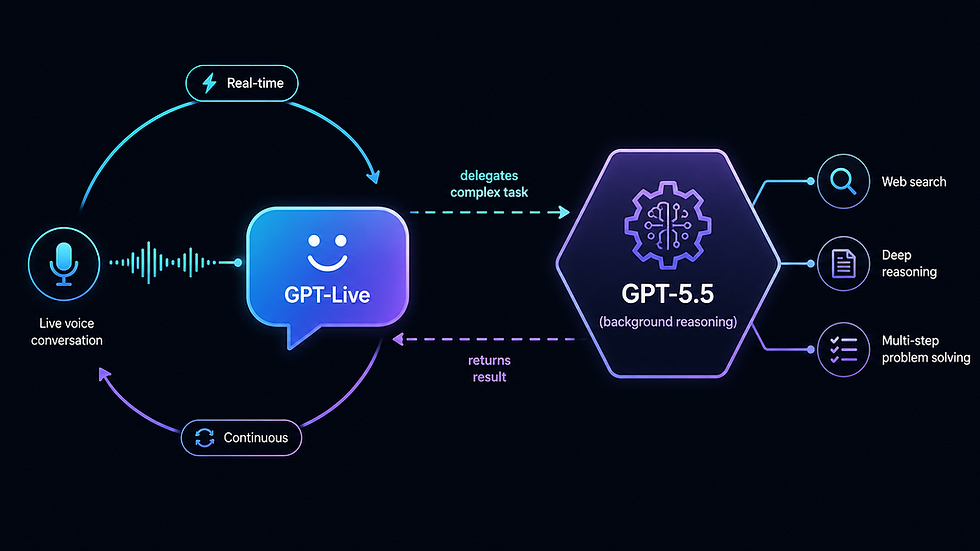
A common challenge in real-time voice AI is the trade-off between speed and intelligence. Deep reasoning takes time, which can break the "magic" of a live conversation. OpenAI solves this in GPT-Live through a sophisticated delegation system.
While GPT-Live handles the immediate conversational flow and low-latency interaction, it can delegate complex tasks—such as web searches, mathematical calculations, or multi-step reasoning—to a background frontier model, currently GPT-5.5. While the background model processes the heavy lifting, GPT-Live can continue to engage with the user, providing updates or maintaining the conversation until the result is ready to be integrated.
"The architectural change allows GPT-Live to continuously use the latest models and agents, combining frontier intelligence with natural interaction." — OpenAI Official Release
Key Features and User Experience
The rollout of GPT-Live brings several enhancements to the ChatGPT ecosystem that extend beyond simple voice quality:
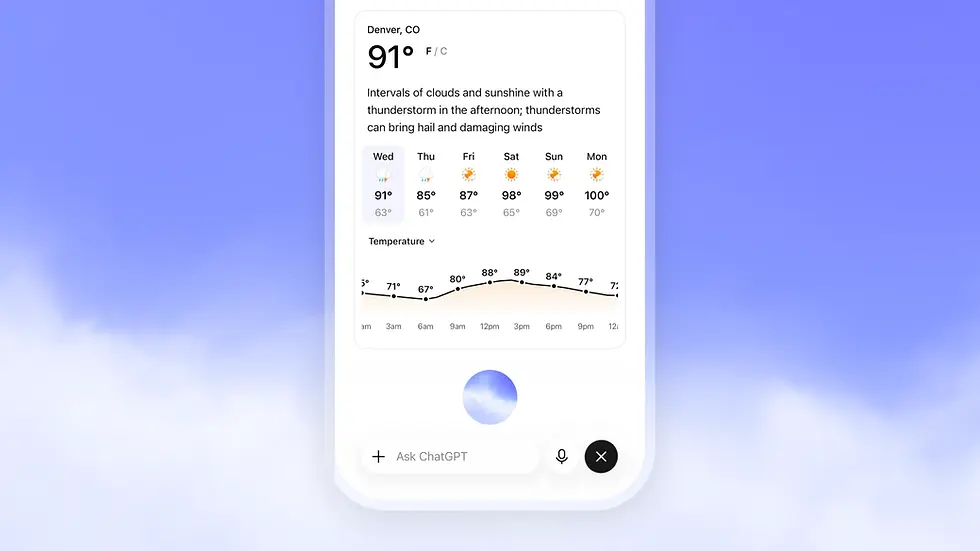
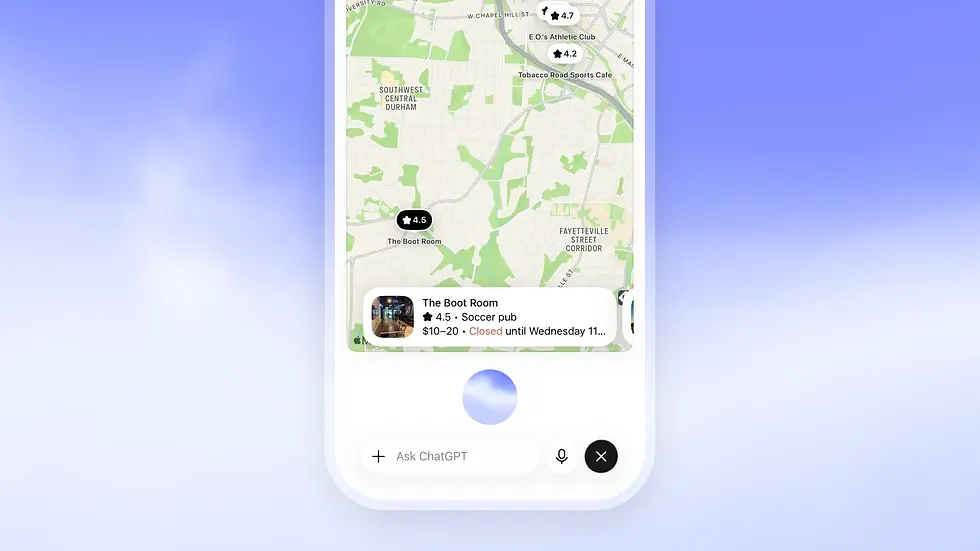
Visual Cards: For the first time, ChatGPT Voice can provide visual context during a conversation. Users asking about weather, stock prices, or sports scores will see rich visual cards appear on their screen, providing a multimodal experience that complements the spoken word.
Remastered Voices: OpenAI has remastered its nine distinct voices specifically for the GPT-Live architecture, ensuring they sound more expressive and human-like across various emotional contexts.
Real-Time Translation: The full-duplex nature of the model makes it an ideal tool for live translation. Two people speaking different languages can use GPT-Live as a mediator, with the model translating and speaking in real-time with minimal lag.
Improved Noise Handling: GPT-Live is significantly better at distinguishing the user's voice from background noise, such as traffic or other people talking, reducing the likelihood of the AI becoming "distracted."
Performance Benchmarks
The impact of the delegation architecture is most visible in technical benchmarks. By handing off complex queries to GPT-5.5, GPT-Live-1 achieves scores that were previously impossible for live voice models.
Benchmark Comparison: GPT-Live vs. Advanced Voice Mode
Benchmark | Test Focus | Advanced Voice Mode | GPT-Live-1 (High Reasoning) |
GPQA | Graduate-level Scientific Reasoning | 45.3% | 84.2% |
BrowseComp | Agentic Web Search | 0.7% | 75.2% |
τ³-Voice Telecom | Multi-turn Support Tasks | ~30% Success | ~65% Success |
The jump in BrowseComp is particularly noteworthy. It demonstrates that GPT-Live is not just a better "talker," but a capable agent that can navigate the web and find specific information while keeping the user engaged in a live session.
Safety and Ethical Considerations
As AI becomes more human-sounding, the risks of emotional dependency and deception increase. OpenAI has implemented several layers of safety specifically for GPT-Live:
Continuous Safety Monitoring: The system can detect potentially unsafe output in real-time while the model is speaking and steer the conversation toward a safer path or terminate it if necessary.
Age-Appropriate Behavior: Dedicated training ensures the model behaves appropriately for younger users, with parental controls available to manage access.
Anti-Impersonation Safeguards: GPT-Live is restricted to using its predefined set of voices and includes safeguards to prevent it from imitating real people or specific individuals.
Emotional Reliance Monitoring: OpenAI has committed to long-term monitoring of how users interact with these more expressive models to identify and mitigate patterns of unhealthy emotional reliance.
GPT-Live represents a milestone in the journey toward truly natural human-AI collaboration. By breaking the barriers of turn-based interaction and decoupling conversational flow from deep reasoning, OpenAI has created a tool that feels less like a software interface and more like a capable partner. As this technology continues to evolve, the distinction between "talking to a computer" and "having a conversation" will only continue to blur.
For more inform
For more information on availability and pricing, visit the OpenAI Help Center.
Reference Videos
To see GPT-Live in action, you can refer to the official demonstrations provided by OpenAI:
GPT-Live: Background Delegation and Reasoning - A deep dive into how GPT-Live interacts with GPT-5.5 for complex tasks.
Comments