


Meta Renews Its Wearables and AI Line: Lighter Glasses, Personal Agents, and Generative Tools

Meta used Connect 2026 to present a broader vision for everyday artificial intelligence: glasses that are easier to wear all day, a personal agent that can continue working after the user leaves the app, and creative tools that turn prompts, images, and short videos into new media. The announcements connect hardware, software, and services more tightly than previous product updates.
The central product refresh is the Ray-Ban Meta Audio line, which removes the camera and focuses on open-ear sound and voice access to AI. Meta also introduced Ray-Ban Meta Gen 3, a slimmer camera-equipped model with longer battery life, while expanding its own Meta Glasses family and adding more styles across Ray-Ban, Oakley, and Meta-branded frames. 1 2
A lighter path for smart glasses
The Ray-Ban Meta Audio glasses are designed for people who want the main benefits of a connected wearable without a camera. Meta says they are its slimmest and lightest frames so far. They use microphones, open-ear speakers, and voice control for calls, music, messages, and Meta AI. The company states that the glasses can run for up to 12 hours and support a range of prescription lenses. The first styles are Clubmaster and Burbank. 1
The camera-free design addresses a persistent social problem. A recording light can signal when camera-equipped glasses are active, but that signal does not remove every concern about consent or surveillance. The Guardian reported that the Audio models are thinner and lighter than the camera versions, start at £319 in the United Kingdom, and may appeal to people who want a more discreet wearable. 2
Ray-Ban Meta Gen 3 keeps the camera while reducing friction in daily use. Meta describes a slimmer and more comfortable frame, a new action button for quicker access to Meta AI, and the longest battery life in the Ray-Ban Meta family. Two new silhouettes, Aviator and Zena, broaden the range beyond the familiar Wayfarer shape. The Guardian reported up to nine hours of battery life and Dolby Atmos support, with a United Kingdom price of £409. 1 2
The update is not only about industrial design. Meta is also adding hearing enhancement to supported AI glasses in the United States later this year, alongside audio balance and mono-audio controls. The company describes the hearing feature as FDA-cleared software for adults with perceived mild to moderate hearing loss. It also announced hands-free guided workouts, nutrition tracking, shopping assistance, landmark-based walking directions, and Dolby Atmos capture for compatible glasses. Availability varies by country and model. 1
Meta’s official product page presents the wider range as a platform rather than a single device. Current features include hands-free photos and video, open-ear audio, calls, messages, translation, reminders, and visual questions such as identifying an object or reading text. The same page lists Ray-Ban Meta Gen 3, Audio styles, Meta Glasses, Oakley Meta models, and Meta Ray-Ban Display products. 3
From a voice assistant to a personal agent
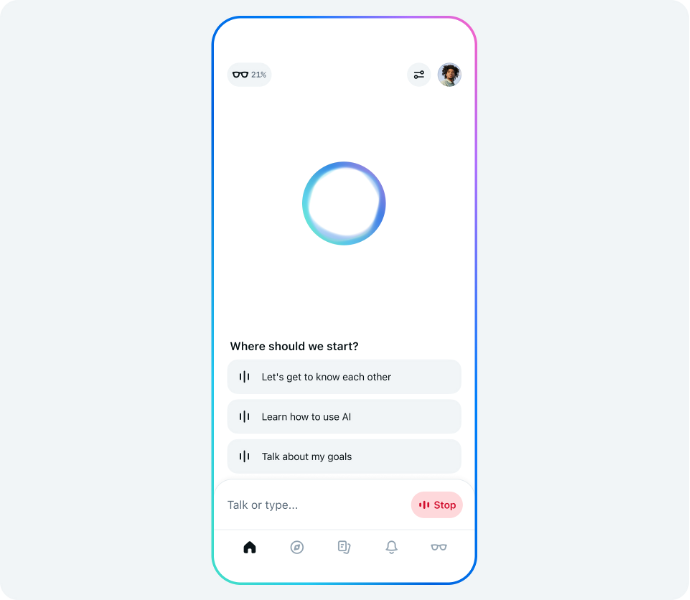
The more consequential announcement may be Muse, Meta’s personal AI agent. Meta introduced it in September 2026 as a system intended to do work instead of only answering questions. It can help plan goals, send email, book travel, browse the web, fill out forms, and continue a task after the user closes the app. Meta says Muse is rolling out in the United States on iOS, Android, and the web, with access to AI glasses planned for the near future. 4
Muse runs inside a dedicated cloud computer called Muse Secure VM. Meta says the environment separates the agent and the person’s data from other users, stores connected credentials securely, and uses a separate Sentinel system to approve internet activity. The agent is meant to ask before sensitive actions such as sending an email or making a purchase, while providing an audit trail of actions and planned steps. Users can disconnect services, change permissions, and ask Muse to forget information. 4
At Connect, Meta described the next step: Muse will be reachable from AI glasses by saying the agent’s name. The agent can respond to what the wearer is looking at, such as a product on a shelf, a poster, or a long list. Meta also presented Muse Realtime Voice and an interactive avatar system, plus Muse Charm, a small pocket device built for talking with Muse. Meta said it would share more about Muse Charm later in the year, which places it closer to an emerging hardware concept than a fully detailed mass-market product. 1
This direction extends Meta’s earlier Meta AI app. In 2025, the company introduced an app built with Llama 4 that combined voice conversations, personalization, image generation, editing, and continuity with its AI glasses. The app could remember details users chose to share, while a Discover feed let people explore prompts and examples from others. 5
The promise is continuity: start a question on glasses, continue it on a phone, and let an agent handle a multi-step project in the background. The risk is also continuity. A system that remembers preferences, sees surroundings, accesses accounts, and can act on a user’s behalf requires clear permissions, understandable logs, and reliable limits. Meta’s Secure VM and approval controls are an attempt to make that trust model visible, but real-world use will determine whether the protections feel sufficient.
Generative tools move closer to the everyday feed
Meta’s generative AI tools are becoming less separate from ordinary social and creative workflows. In Meta AI, a user can generate an image from a prompt and animate it into a short video, called a “vibe.” Users can also upload an image or video for editing, add music, and create voiceovers or lip-sync effects. Meta’s help documentation notes that availability depends on location and that generated content remains subject to platform rules. 6
The workflow is intentionally simple: describe an image, choose a result, tap Animate, add a prompt or music, and publish to the Meta AI and Vibes feed. That lowers the technical barrier for short-form content, but it also increases the need for labeling, consent, and attention to misleading edits. Meta says it labels AI-generated images created with its own products in relevant cases and warns that generated responses can be inaccurate or inappropriate. 6
The connection with glasses is clear. Wearables can capture a moment hands-free, ask Meta AI about it, and then turn the material into a post or an edited clip. A personal agent could organize the files, create a draft, or prepare a shopping list from something the wearer saw. These are useful examples, but they also show why privacy settings cannot remain hidden in a companion app. The user needs to know when a camera is recording, when audio is being analyzed, which memories are retained, and which actions require approval.
Closing Thoughts
Meta is presenting glasses as the most natural access point for an AI that follows the user through the day. The lighter Audio models make that idea easier to accept because they remove the camera and focus on sound. Gen 3 keeps the richer camera experience for people who want hands-free capture and visual assistance. Muse then supplies the missing software layer: memory, planning, and the ability to perform tasks.
The strategy is coherent, but convenience alone will not decide whether these products become ordinary. People will judge them in public spaces, at home, and around friends who did not choose to be part of an AI system. Meta’s challenge is to make privacy signals, permissions, and limits as understandable as the voice command itself.
What is the practical takeaway here?
Meta is no longer treating smart glasses as a single camera accessory. It is building a family of devices with different trade-offs: camera-free audio frames, camera-equipped Ray-Ban Gen 3, display glasses, and more specialized Meta and Oakley options. At the same time, Muse is meant to turn an assistant into an agent that can remember context and complete tasks.
For users, the sensible approach is to choose the narrowest device and permissions that match the intended use. Audio glasses may be preferable for calls and music. Camera models add visual AI and hands-free capture but require greater awareness of other people. Agent features should be connected selectively, with approval controls enabled for messages, purchases, and account changes.
Why does this make a difference?
The announcements place AI in the spaces where people already spend time: walking, shopping, traveling, messaging, creating, and working. A lighter frame can make a wearable more comfortable. A personal agent can reduce repetitive digital work. Generative tools can let more people create images and short videos without specialized software.
The same shift changes the standard for responsible design. When AI can see through glasses, remember personal details, generate media, and act online, trust becomes part of the product experience. Meta’s renewed line will be judged not only by battery life or frame weight, but by how clearly it shows what the system knows, what it is doing, and when a person remains in control.
References
Comments