


Immigration as a Demographic Engine: How Switzerland Defies Europe's Population Decline

The European continent is standing at a historic demographic crossroads. Across the European Union, birth rates are plummeting, populations are aging rapidly, and the working-age demographic is shrinking at an alarming rate. Yet, nestled in the heart of this demographic winter, Switzerland presents a striking anomaly. While its neighbors grapple with the economic fallout of a diminishing workforce, Switzerland's population continues to grow robustly, driven almost entirely by the strategic influx of highly skilled foreign labor. This article explores the stark contrast between the broader European demographic decline and the Swiss model of immigration-fueled growth, analyzing the economic benefits, the political tensions, and the structural realities of an "immigration superpower."
The European Demographic Winter
The demographic trajectory of the European Union paints a sobering picture for the continent's economic future. According to projections by the European Commission and Eurostat, the EU population, currently hovering around 450 million, is expected to peak slightly by 2029 before embarking on a steady decline, potentially shrinking by over 50 million people by the end of the century [1] [2].
More concerning than the absolute population decline is the structural shift in age demographics. The working-age population (defined as individuals between 20 and 64 years old) is projected to shrink by an average of 1.2 million people annually between 2025 and 2050 [3]. Simultaneously, the proportion of citizens aged 65 and older is expected to double by 2100, creating an unprecedented dependency ratio [2]. This demographic inversion threatens to strain pension systems, overwhelm healthcare infrastructure, and severely hamper economic productivity across the bloc.
Countries like Germany, Italy, and Spain are already feeling the acute effects of this labor shortage. Despite decades of political rhetoric emphasizing the need to attract skilled professionals from abroad, many European nations have struggled to implement effective, large-scale talent acquisition strategies, often losing out in the global competition for highly qualified workers [4].
The Swiss Exception: Growth Through Talent
In stark contrast to the broader European trend, Switzerland's population has doubled since 1950, growing from 4.3 million to over 8.7 million today [4]. This growth is not the result of exceptionally high domestic birth rates, but rather a direct consequence of sustained, high-volume immigration.
As of 2023, foreign nationals accounted for approximately 27% of Switzerland's permanent resident population [5]. When factoring in naturalized citizens and second-generation immigrants, an astonishing 41% of the permanent resident population aged 15 and over has a migration background [6].
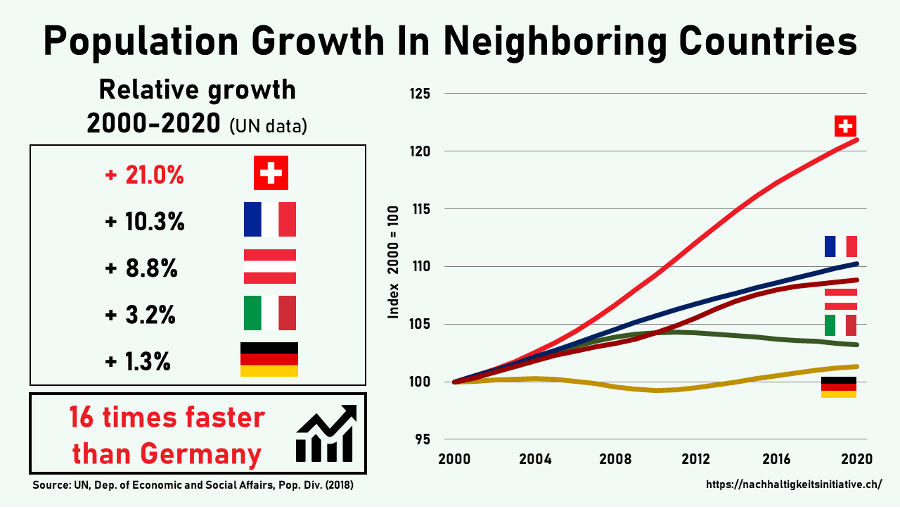
What distinguishes the Swiss immigration model is not just the volume of arrivals, but the composition of the migrant workforce. Switzerland has effectively positioned itself as a global magnet for highly skilled professionals. The employment rate among international residents is exceptionally high at 77%, and nearly half of these individuals hold highly qualified positions [7].
The country leverages its unique structural advantages to attract top-tier talent. Embedded in the center of Europe with access to a labor market of over 300 million people through bilateral agreements with the EU, Switzerland offers a compelling combination of high wages, a flexible labor market, world-class infrastructure, and a highly efficient public sector [4].
Factor | European Union Average | Switzerland |
Projected Population Trend (2025-2050) | Decline | Growth |
Foreign-Born Population Share | ~13% | ~31.7% |
Primary Driver of Growth | Stagnant/Negative | High-Skilled Immigration |
The Economic Engine of Immigration
The economic dividends of this demographic strategy are profound. Roughly half of Switzerland's long-term economic growth—averaging around 1% annually—can be directly attributed to the expansion of its workforce through immigration [4]. The other half is driven by productivity gains, which are themselves deeply intertwined with the influx of specialized talent.
Switzerland's core industries are structurally dependent on foreign expertise. The pharmaceutical giants in Basel, the financial institutions in Zurich, the precision manufacturing sector, and world-renowned research institutions like ETH Zurich rely heavily on the continuous recruitment of international scientists, engineers, and financial experts. Furthermore, the Swiss healthcare system is sustained by a significant proportion of foreign-trained medical professionals.

Without this steady stream of skilled immigration, Switzerland would not merely be a smaller nation; it would be a structurally weaker economy, incapable of maintaining its current levels of innovation and global competitiveness [4].
Political Tensions and the "10 Million" Debate
Despite the undeniable economic benefits, the sheer scale of immigration has generated significant political friction within Switzerland. The rapid population growth has placed pressure on housing markets, transportation infrastructure, and social cohesion, leading to a persistent and polarizing national debate regarding the limits of growth.
This tension is most visibly manifested in political initiatives aimed at curbing immigration. The recent "No to 10 Million" initiative, championed by conservative factions, proposes a hard cap on the country's population, arguing that unchecked growth threatens the Swiss landscape, infrastructure, and national identity [4].

However, economic experts and business leaders warn that implementing a hard population limit would be tantamount to economic self-sabotage. Rationing access to the labor market would force Switzerland to turn away the very talent that sustains its most productive industries. In a highly mobile global talent market, skilled workers denied entry to Switzerland would simply relocate to competing hubs in North America, Asia, or other reforming European nations [4].
The paradox of Swiss immigration politics is that while the populace frequently expresses anxiety over "over-foreignization" (Überfremdung), the economy remains fundamentally addicted to foreign labor. The challenge for Swiss policymakers is not to halt immigration, but to manage its externalities—such as investing heavily in housing and infrastructure—while maintaining the country's status as an attractive destination for global talent.
As Europe faces the daunting reality of a shrinking and aging workforce, Switzerland stands as a testament to the power of strategic immigration as a demographic and economic engine. By successfully channeling global talent into high-value sectors, Switzerland has transformed a potential demographic vulnerability into a formidable competitive advantage.
The ongoing political debates regarding population caps highlight the genuine challenges of rapid growth in a small, geographically constrained nation. Nevertheless, the fundamental reality remains: Switzerland is not succeeding despite its high levels of immigration; it is succeeding precisely because of them. In the global race for human capital, Switzerland has established itself as an undisputed immigration superpower, offering a compelling, albeit politically complex, blueprint for demographic resilience in the 21st century.
References
[1] European Commission. "Demographic change in Europe." https://commission.europa.eu/topics/employment-and-social-affairs/demographic-change-europe_en
[2] Eurostat. "Population projections in the EU." https://ec.europa.eu/eurostat/statistics-explained/index.php?title=Population_projections_in_the_EU
[3] LIGA.net. "EU working-age population to shrink by 1.2 million annually." https://news.liga.net/en/society/news/eu-working-age-population-to-shrink-by-12-million-annually-european-commission-forecast
[4] Thiel, Alexander R. "Switzerland: An Immigration Superpower." The Globalist, June 12, 2026. https://www.theglobalist.com/switzerland-an-immigration-superpower/
[5] Wikipedia. "Immigration to Switzerland." https://en.wikipedia.org/wiki/Immigration_to_Switzerland
[6] Federal Statistical Office (FSO). "Population by migration status." https://www.bfs.admin.ch/bfs/en/home/statistics/population/migration-integration/by-migration-status.html
[7] SWI swissinfo.ch. "Our analysis unpacks how demographic change and workforce migration are transforming Switzerland." https://www.facebook.com/swissinfo/posts/our-analysis-unpacks-how-demographic-change-and-workforce-migration-are-transfor/1421267066715823/
Comments