


Global Debate on Labor Markets and AI: Entry-Level Pressure, Specialist Demand, and a Mixed Outlook

Artificial intelligence is changing the labor market in two directions at once. It can reduce the need for routine work, especially in junior office roles, while increasing demand for people who can design, supervise, interpret, secure, and apply advanced systems. Recent reports do not support a simple story of mass replacement. They point instead to a difficult transition in which access to first jobs may become harder even as specialized and technical opportunities expand.
Why the evidence looks mixed
The World Economic Forum’s Future of Jobs Report 2025 projects that global forces could create 170 million jobs and displace 92 million by 2030, producing a net gain of 78 million jobs. The same report estimates that job disruption could affect 22% of current roles. These figures are projections based on employer expectations, not a guarantee, but they show why the debate cannot be reduced to either “AI destroys work” or “AI creates work.” 1
The composition of employment is changing faster than the total number of jobs. Cashiers, administrative assistants, and some design tasks face pressure because software can now handle parts of their work at low cost. At the same time, demand is growing for roles linked to artificial intelligence, data, cybersecurity, renewable energy, environmental engineering, health care, education, and other essential services. The result is a labor market with more movement between occupations and a higher premium on adaptable skills. 1
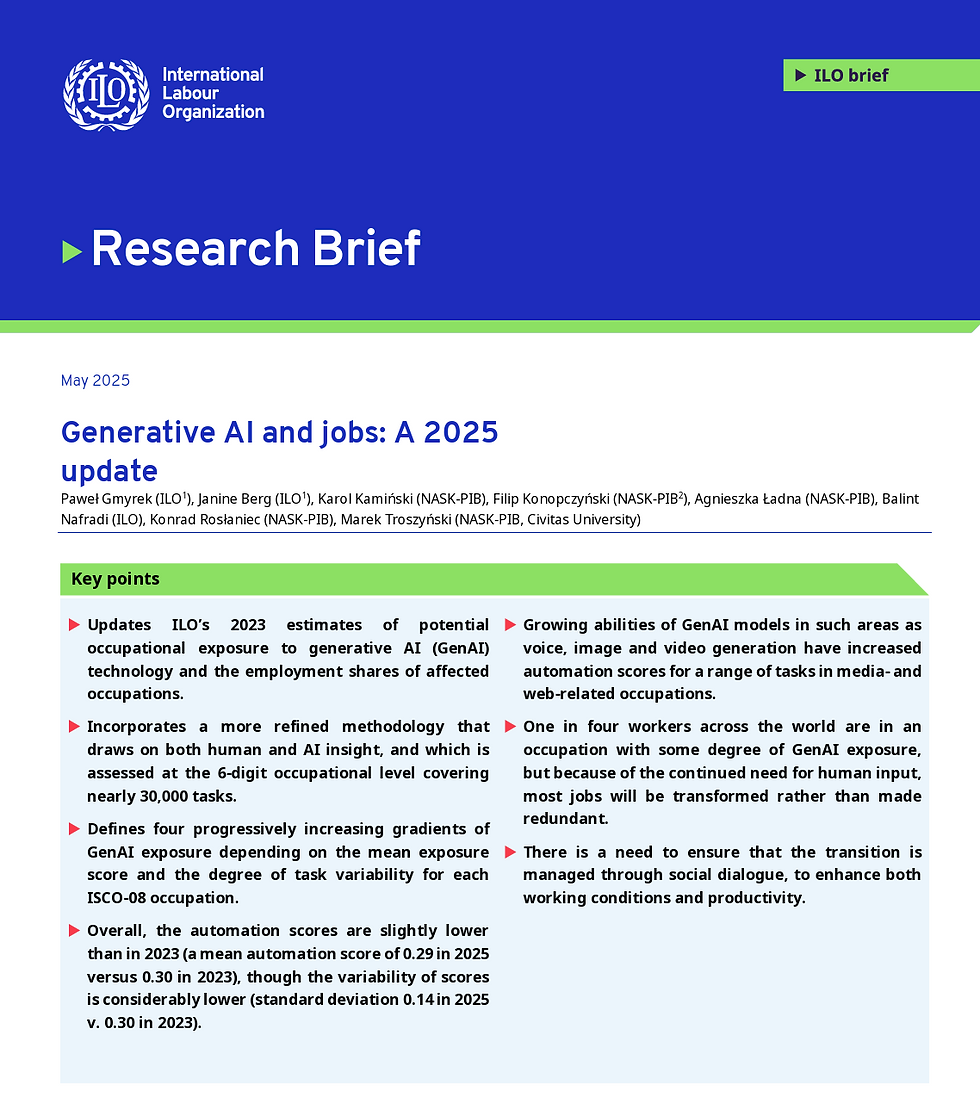
The International Labour Organization offers an important qualification. Its 2025 update estimates that one in four workers worldwide is in an occupation with some exposure to generative AI. Exposure does not mean that a person will lose a job. The ILO finds that most occupations still contain tasks requiring human judgment, communication, responsibility, or physical presence, so transformation is more likely than full redundancy in many cases. 2
That distinction is central. AI often automates a task before it eliminates an occupation. A customer-service representative may use a model to draft replies, while still handling unusual cases. A junior analyst may use software to summarize documents, while checking evidence and explaining the result. A technician may receive automated diagnostics, while deciding whether a repair is safe. The job changes because the task mix changes.
The entry-level squeeze
The first rung of the career ladder is receiving special attention because many entry-level jobs contain repeatable activities: preparing routine reports, sorting information, writing standard messages, processing simple requests, and producing first drafts. These tasks are increasingly easy for AI systems to assist or perform.
PwC’s 2026 AI Jobs Barometer describes a two-track market. In the most AI-exposed jobs, the required skills are changing more than twice as fast as in the least exposed jobs. The report also finds that junior roles with high AI exposure are seven times more likely to ask for skills traditionally associated with senior workers, such as leadership and strategic thinking. Early-career postings have flattened in highly exposed sectors, while entry-level roles redesigned around more advanced responsibilities grew by 35% since 2019. 4
This creates a serious access problem. If routine junior work disappears, new workers may have fewer opportunities to learn through supervised practice. Employers may expect graduates to arrive with stronger judgment, communication, data literacy, and business understanding from the first day. Yet those skills are often built through the very entry-level experiences that are now being compressed.
The risk is not identical for every graduate or every country. A large technology company may replace a junior reporting task with an AI tool while hiring more engineers, product specialists, security experts, and client advisers. A small firm may use the same tool to raise the output of a small team without hiring anyone. A public agency may adopt AI slowly because of privacy, procurement, or accountability rules. Outcomes will depend on business strategy, labor institutions, education systems, and the availability of training.
Why technical and specialized demand remains strong
The OECD’s 2026 report, AI and skills, offers a useful correction to the idea that everyone must become an AI programmer. Fewer than 1% of workers are expected to need advanced AI-specific skills such as model development. Most workers will need practical digital ability, including the capacity to use, analyze, and interpret data. Managerial skills, problem-solving, creativity, and innovation also remain important. 3
AI can raise the value of specialists because it makes their expertise more productive. A cybersecurity professional can review more alerts. An engineer can test more design options. A medical researcher can search larger bodies of evidence. An energy specialist can monitor complex systems more effectively. In each case, the tool expands the reach of professional knowledge, but it does not remove the need for domain judgment.
The OECD reports that more than half of employers in manufacturing and finance that have adopted AI see a greater need for highly educated workers. Skills shortages are also preventing many companies from adopting AI: about 40% of employers in manufacturing and finance that have not adopted the technology cite a lack of skills as a main barrier. 3
The World Economic Forum reaches a similar conclusion from a wider employer survey. AI, big data, and networks and cybersecurity are among the fastest-growing technical skill areas. Analytical thinking, resilience, leadership, collaboration, and creative thinking remain valuable at the same time. The strongest candidates will often combine both groups rather than choose between technical and human capabilities. 1

Productivity does not automatically mean fewer workers
A common assumption is that higher productivity must lead directly to lower employment. The recent evidence is more conditional. PwC reports that productivity growth is 40% higher at companies most exposed to AI than at the least exposed companies. It also reports faster headcount and wage growth among the most exposed companies in its sample, suggesting that some firms use AI to expand output, enter new markets, or create new services rather than only cut costs. 4
That possibility does not remove the risk of displacement. A firm can grow while reducing a particular category of work. A department may need fewer people for routine document production but more people for sales, compliance, implementation, or technical support. Workers who can move into the new activities may benefit; workers without time, training, or access to those paths may not.
The WEF survey captures this tension. Seventy-seven percent of employers plan to upskill workers, while 41% expect to reduce their workforce as AI automates certain tasks. Almost half expect to move some employees from roles exposed to AI into other parts of the business. 1 The outcome will depend on whether firms treat training as a real transition pathway or as a slogan attached to a reduction plan.
The policy question: who gets the next opportunity?
The central public question is not only how many jobs will exist. It is who will be able to reach them. The WEF estimates that 59 out of 100 workers may need reskilling or upskilling by 2030, and 11 of those may not receive it. 1 The ILO calls for social dialogue so that workers, employers, and public institutions can shape the use of AI together. 2
A credible response would connect education, employer training, and hiring practices. Schools and universities can strengthen data literacy, critical reasoning, communication, and applied projects. Employers can create paid training, apprenticeships, mentoring, and clear internal mobility routes. Governments can support small firms and workers who cannot finance training on their own, while requiring transparency when automated systems affect evaluation, scheduling, or recruitment.
Early-career workers need special protection because they have less bargaining power and fewer alternatives. Companies that remove junior tasks should explain how new employees will gain experience. A responsible pathway might pair AI-assisted work with supervised case analysis, client communication, quality checks, and rotations across teams. That approach preserves learning while still capturing productivity gains.
Closing Thoughts
The most credible reading of the current evidence is neither alarmist nor complacent. AI is likely to remove or compress some tasks, especially those that are repetitive and easy to standardize. It is also likely to increase the value of specialists who understand a field deeply and can use AI with judgment.
The key test will be the quality of the transition. If organizations use AI only to reduce payroll, the entry-level squeeze will deepen and the benefits will be uneven. If they use it to expand services, train people, and redesign jobs around human responsibility, the technology can support broader productivity and stronger professional work.
A labor market with more technical demand is not automatically fairer. Access to training, paid experience, reliable education, and transparent hiring will determine whether the new opportunities are widely available or concentrated among people who already have advantages.
What does this look like in practice?
A junior marketing employee may stop spending hours formatting campaign variations and instead compare audience data, test messages, and explain why a recommendation should be trusted. A new engineer may use AI to generate design options but remain responsible for safety constraints, testing, documentation, and communication with clients. A help-desk worker may receive automated answers for common questions and focus on escalations that require empathy and diagnosis.
In each example, the entry-level role is not simply deleted. It is rebuilt. The worker must check outputs, identify errors, understand the customer or system, and make decisions when the tool is uncertain. Employers therefore need to teach verification, not only prompt writing. They also need evaluation methods that reward learning and sound judgment rather than raw speed alone.
How does this impact us?
For workers, the practical priority is to build a combination of digital fluency, subject knowledge, communication, and evidence-based judgment. People do not need to become machine-learning researchers to benefit from AI, but they do need to understand what the tool can do, where it fails, and how to check its work.
For employers, the choice is between treating AI as a cost-cutting device and using it as a capability multiplier. The second path requires investment in training, clearer responsibilities, and a deliberate plan for early-career development.
For governments and educators, the challenge is to make learning available before displacement occurs. The most useful response will combine technical education with apprenticeships, labor protections, career guidance, and access to lifelong training. The debate should focus less on predictions of a single future and more on the decisions that will shape who benefits from the technology.
References
Comments