


Defending Against "Model Collapse": Researchers Present Solutions to Prevent AI Degradation in Recursive Training

As generative artificial intelligence (AI) systems permeate digital communication channels, the proportion of synthetic text and imagery on the internet increases exponentially. Recent empirical and theoretical investigations demonstrate that training successive generations of machine learning models predominantly on AI-generated content triggers a degenerative phenomenon known as model collapse. This recursive loop strips away the rare, nuanced features of original human data distributions, ultimately causing neural networks to output repetitive, degraded nonsense. This article examines the theoretical underpinnings of model collapse, the mechanisms driving statistical error accumulation, and cutting-edge defenses proposed by computer science researchers—such as rigorous data curation, cryptographic watermarking, and reinforcement-based filtering—designed to safeguard the future of machine learning ecosystems.
The Synthetic Feedback Loop
The rapid proliferation of large language models (LLMs) and diffusion architectures has fundamentally transformed how digital content is created and consumed. Platforms across the web are increasingly flooded with automated prose, synthetic imagery, and computer-generated code. While this explosion of synthetic data offers unprecedented scale, it introduces a profound systemic hazard to the architecture of artificial intelligence itself. Because modern training pipelines rely heavily on large-scale web scraping, future models are inevitably trained on data produced by their predecessors [1].
This closed-loop ingestion creates what researchers describe as an autophagous or self-consuming feedback loop [2]. When an AI model learns from synthetic artifacts rather than genuine human interactions, errors, biases, and distributional approximations compound over successive generations. The consequence is an irreversible erosion of model fidelity. Understanding this vulnerability is essential for sustaining long-term technological progress across computational science.

"Indiscriminate use of model-generated content in training causes irreversible defects in the resulting models, in which tails of the original content distribution disappear." — Shumailov et al., Nature [1]
Theoretical Foundations of Model Collapse
To comprehend how model collapse occurs, researchers analyze three primary sources of error that compound during recursive training cycles: statistical approximation error, functional expressivity error, and functional approximation error [1].
Statistical approximation error arises primarily from finite sample sizes. Because any dataset represents a limited sample of an underlying reality, low-probability events—often referred to as the "tails" of a probability distribution—are underrepresented or entirely absent. When a generative model learns from this finite sample, it assigns zero or near-zero probability to those rare occurrences. In the next generation, those tails vanish completely.
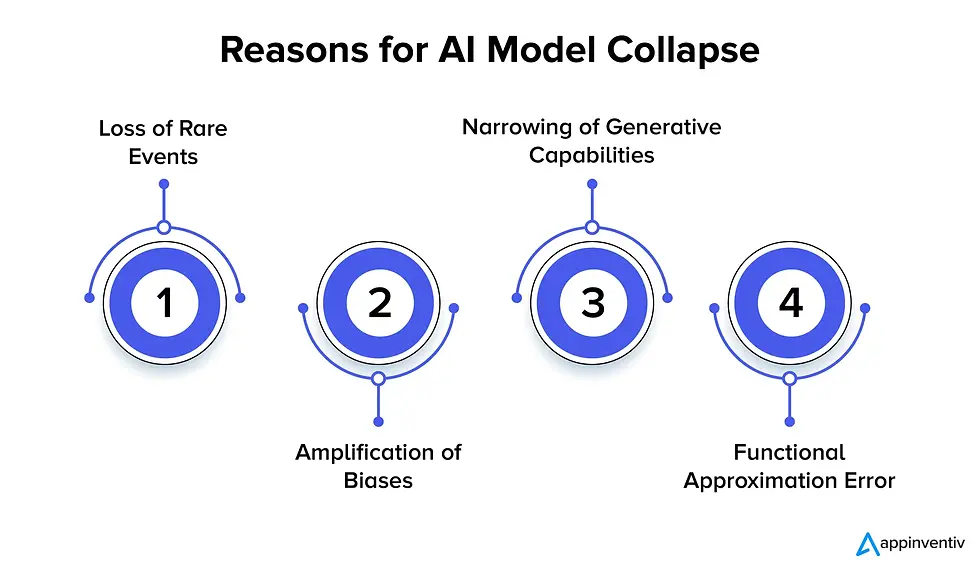
Functional expressivity error occurs due to the structural limitations of neural networks. Even universal approximators possess bounded capacity in finite configurations, leading to systematic misestimations of complex probability densities. Finally, functional approximation error stems from optimization biases, such as those introduced by stochastic gradient descent during objective minimization [1].
Comparative Overview of Error Propagation in Recursive Training
Error Category | Primary Driver | Manifestation Across Generations | Long-Term Systemic Impact |
Statistical Approximation | Finite sample sizes and stochastic sampling | Gradual erosion of low-probability tail events | Convergence toward restricted mean outputs with minimal variance |
Functional Expressivity | Bounded architectural capacity | Systematic misrepresentation of complex multi-modal distributions | Distortion of underlying semantic boundaries and decision surfaces |
Functional Optimization | Gradient descent bias and objective function design | Overfitting to high-density clusters while neglecting outliers | Loss of creative diversity and generalization capability |
Empirical Evidence and Manifestations
Empirical studies conducted across various generative architectures—including variational autoencoders (VAEs), Gaussian mixture models (GMMs), and advanced transformers—reveal that model collapse is a universal phenomenon [1]. In early model collapse, a model begins losing information about rare events and edge cases, concentrating its probability mass exclusively on high-density modal centers. In late model collapse, the degradation becomes severe, causing the output distribution to collapse into a degenerate point estimate with virtually zero variance [1].
![Empirical Distribution Shrinkage in Recursive Training]](https://static.wixstatic.com/media/3d7840_e25211082ead427ca9a8cdfee59ba5ad~mv2.png/v1/fill/w_980,h_1057,al_c,q_90,usm_0.66_1.00_0.01,enc_avif,quality_auto/3d7840_e25211082ead427ca9a8cdfee59ba5ad~mv2.png)
For language models, this degeneration manifests as linguistic drift, semantic repetition, and grammatical decay. When queried, collapsed models increasingly produce outputs that resemble homogenous boilerplate text rather than coherent, context-rich prose.
Cutting-Edge Solutions and Defenses
Recognizing the severity of this impending data crisis, researchers from academic institutions and industrial laboratories have proposed rigorous countermeasures. These solutions aim to filter, curate, and fortify training pipelines against synthetic pollution.
Rigorous Data Curation and Provenance Tracking
A primary defense involves identifying and filtering out synthetic content before it enters training corpora [3]. Advanced classifiers and heuristic detectors are deployed during web crawling phases to flag machine-generated text and image patterns [4]. Furthermore, cryptographic watermarking techniques embedded directly into generation frameworks allow downstream consumers to trace the provenance of digital assets instantly.
Reinforcement-Based Filtering and Quality Control
Recent studies from research teams at New York University and Meta AI demonstrate that scaling up with synthetic data is viable only when paired with reinforcement mechanisms [5]. By employing external verifiers—such as human evaluators, separate benchmark models, and mathematical oracles—developers can rank and select only the highest-quality synthetic samples [5].
"With careful data curation, we can actually push model performance beyond that of the generator. This approach could pave the way for continued AI advancement even in a world awash with synthetic data." — NYU Center for Data Science [5]
Preservation of Human-Generated Archives
Another crucial strategy involves establishing protected repositories of verified, human-generated data. Archives containing historical literature, peer-reviewed scientific publications, and authenticated human interactions serve as immutable anchor points, preventing recursive drift during long-term model development.
The phenomenon of model collapse poses a formidable challenge to the sustained evolution of artificial intelligence. As synthetic content saturates the digital ecosystem, indiscriminate web scraping accelerates the degradation of successive model generations. However, through rigorous data provenance tracking, advanced multi-stage filtering, and reinforcement-curated synthetic datasets, the research community is forging robust defenses. Safeguarding the integrity of machine learning requires an unwavering commitment to preserving authentic human knowledge and maintaining rigorous quality standards across all training pipelines.
References
[1] I. Shumailov, Z. Shumaylov, Y. Zhao, N. Papernot, R. Anderson, and Y. Gal, "AI models collapse when trained on recursively generated data," Nature, vol. 631, pp. 755–759, 2024. [Online]. Available: https://www.nature.com/articles/s41586-024-07566-y
[2] Reddit Science Discussion, "AI models collapse when trained on recursively generated data," r/science, Aug 2024. [Online]. Available: https://www.reddit.com/r/science/comments/1ec43k2/ai_models_collapse_when_trained_on_recursively/
[3] University of California San Diego, "Preventing Model Collapse in the Synthetic-Data Era," Lecture Notes, 2025. [Online]. Available: https://cseweb.ucsd.edu/~yuxiangw/classes/AIsafety-2025Fall/Lectures/preventing_model_collapse_suraj.pdf
[4] WitnessAI, "AI Model Collapse: Causes and Prevention," Blog Post, Nov 2025. [Online]. Available: https://witness.ai/blog/ai-model-collapse/
[5] NYU Center for Data Science, "Overcoming the AI Data Crisis: A New Solution to Model Collapse," Medium Publication, Aug 2024. [Online]. Available: https://nyudatascience.medium.com/overcoming-the-ai-data-crisis-a-new-solution-to-model-collapse-ddc5b382e182
[6] YouTube, "AI models collapse when trained on recursively generated data," Video Resource, Aug 2024. [Online]. Available: https://www.youtube.com/watch?v=uHUSSgW4mdI
Reference Video
Video 1: AI models collapse when trained on recursively generated data — A detailed technical breakdown of the Nature publication hosted on YouTube. Available on YouTube [6].
Comments