


Beyond Artemis II: NASA’s Roadmap for a Permanent Human Presence on the Moon


The successful return of the Artemis II crew marks a historic turning point in human space exploration. For the first time in over half a century, humans have ventured into deep space, orbited the Moon, and returned safely to Earth. However, unlike the Apollo era, which was defined by a "flags and footprints" approach, the Artemis program is designed for endurance. NASA’s vision extends far beyond a simple return to the lunar surface; it aims to establish a sustainable infrastructure that will serve as a springboard for the eventual human exploration of Mars [1].

The Immediate Horizon: Artemis III and the Return to the Surface
With the data from Artemis II being meticulously analyzed, NASA’s focus shifts to Artemis III, currently targeted for 2027 [2] [3]. This mission will be the first to land humans on the Moon since Apollo 17 in 1972. A key distinction of Artemis III is its landing site: the Lunar South Pole. This region is of immense scientific interest due to the presence of water ice in permanently shadowed craters—a resource that could be harvested for life support and rocket fuel [8] [9].
Mission | Estimated Launch | Primary Objective |
Artemis III | 2027 | First crewed landing at the Lunar South Pole; testing HLS. |
Artemis IV | 2028 | First mission to the Lunar Gateway; delivery of the I-HAB module. |
Artemis V | 2029 | Deployment of the Lunar Terrain Vehicle (LTV) and ESPRIT module. |
The landing will utilize the Human Landing System (HLS), developed by commercial partners like SpaceX (Starship HLS) and Blue Origin. This public-private partnership model is a cornerstone of the Artemis program, ensuring cost-effectiveness and fostering a new lunar economy [1].
Beyond Artemis II, Building the Gateway: Humanity’s First Lunar Space Station
One of the most ambitious components of the post-Artemis II era is the Lunar Gateway. Unlike the International Space Station (ISS), which orbits Earth, the Gateway will reside in a Near-Rectilinear Halo Orbit (NRHO) around the Moon. This unique orbit provides constant communication with Earth and easy access to both the lunar surface and deep space [4].

The Gateway will serve several critical functions:
Staging Point: A transfer hub where astronauts arriving in the Orion spacecraft can move to lunar landers.
Science Laboratory: A platform for long-term research on deep-space radiation and its effects on the human body.
Communication Relay: Enhancing data transmission between the lunar surface and mission control on Earth.
The first two modules—the Power and Propulsion Element (PPE) and the Habitation and Logistics Outpost (HALO)—are scheduled to launch together on a commercial rocket before the Artemis IV mission [4] [10].
Artemis Base Camp: A Permanent Home on the Moon
Beyond Artemis II,to sustain a long-term human presence, NASA is planning the Artemis Base Camp at the South Pole. This facility will provide the necessary infrastructure for astronauts to live and work on the Moon for weeks or even months at a time [6] [8] [9].
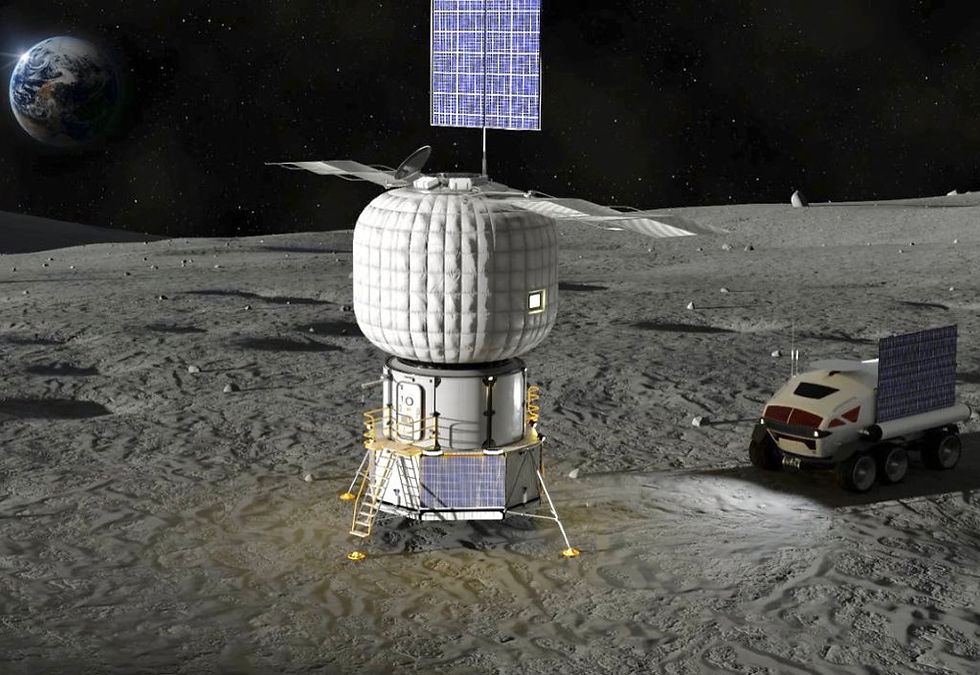
The Base Camp will consist of several key elements:
Foundation Surface Habitat: A pressurized module capable of housing four astronauts.
Lunar Terrain Vehicle (LTV): An unpressurized rover that allows astronauts to explore the surrounding Lunar Cruiser: A pressurized rover that enables long-distance exploration, allowing crews to stay away from the main habitat for up to 45 days.
Fission Surface Power: A nuclear power system to provide reliable energy during the 14-day-long lunar nights.
International Collaboration and the Artemis Accords
The return to the Moon is not a solo endeavor. NASA has partnered with the European Space Agency (ESA), the Japan Aerospace Exploration Agency (JAXA), the Canadian Space Agency (CSA), and many others. This collaboration is governed by the Artemis Accords, a set of principles designed to ensure that space exploration is conducted peacefully, sustainably, and for the benefit of all humanity [1].
"With the Artemis missions, NASA will land the first woman and first person of color on the Moon, using innovative technologies to explore more of the lunar surface than ever before. We will collaborate with commercial and international partners and establish the first long-term presence on the Moon." — NASA Mission Statement [1]
The Path to Mars
Every step taken on the Moon is a preparation for the next giant leap: Mars. The Moon serves as a "testbed" for deep-space technologies. By learning how to extract water from lunar ice, build habitats in extreme environments, and manage long-term radiation exposure, humanity is building the expertise required for a multi-year journey to the Red Planet [1].
The transition from Artemis II to a permanent lunar presence represents a fundamental shift in our relationship with the cosmos. We are no longer just visiting; we are preparing to stay. The infrastructure being built today—the Gateway, the Base Camp, and the commercial partnerships—will ensure that the "Artemis Generation" is the one that finally makes humanity a multi-planetary species.
References
[1] NASA. (n.d.). Moon to Mars | NASA's Artemis Program. Retrieved from https://www.nasa.gov/humans-in-space/artemis/
[2] Nautilus. (2026, April 10). What Comes After Artemis II. Retrieved from https://nautil.us/what-comes-after-artemis-ii-1279734
[3] National Geographic. (2026, April 10). Inside NASA's audacious plan to build a nuclear-powered moon base. Retrieved from https://www.nationalgeographic.com/science/article/what-happens-after-artemis-ii
[4] NASA. (n.d.). Gateway. Retrieved from https://www.nasa.gov/mission/gateway/
[5] U.S. News & World Report. (2026, April 8). What's Next for NASA After Artemis II?. Retrieved from https://www.usnews.com/news/national-news/articles/2026-04-08/explainer-whats-next-for-nasa-after-artemis-ii-a-mission-to-test-lunar-docking-and-mars-tech
[6] Natural History Museum. (n.d.). Why we're returning to the Moon: A guide to the Artemis missions. Retrieved from https://www.nhm.ac.uk/discover/artemis-missions.html
[7] NASA. (2026, March 24). NASA Unveils Initiatives to Achieve America's National Space Policy. Retrieved from https://www.nasa.gov/news-release/nasa-unveils-initiatives-to-achieve-americas-national-space-policy/
[8] NASA. (2020, December). NASA's Lunar Exploration Program Overview. Retrieved from https://www.nasa.gov/wp-content/uploads/2020/12/artemis_plan-20200921.pdf
[9] CBS News. (2026, March 24). NASA unveils ambitious $20 billion plan to build moon base. Retrieved from https://www.cbsnews.com/news/nasa-moon-base-plan-lunar-south-pole/
[10] Live Science. (2026, March 25). NASA announces 'near-impossible' space plans, including $20B moon base and humanity's first nuclear-powered interplanetary spacecraft. Retrieved from https://www.livescience.com/space/space-exploration/nasa-announces-near-impossible-space-plans-including-usd20b-moon-base-and-humanitys-first-nuclear-powered-interplanetary-spacecraft
Comments