


Alibaba’s Zhenwu V900: Asia’s New Bet on AI Compute Independence

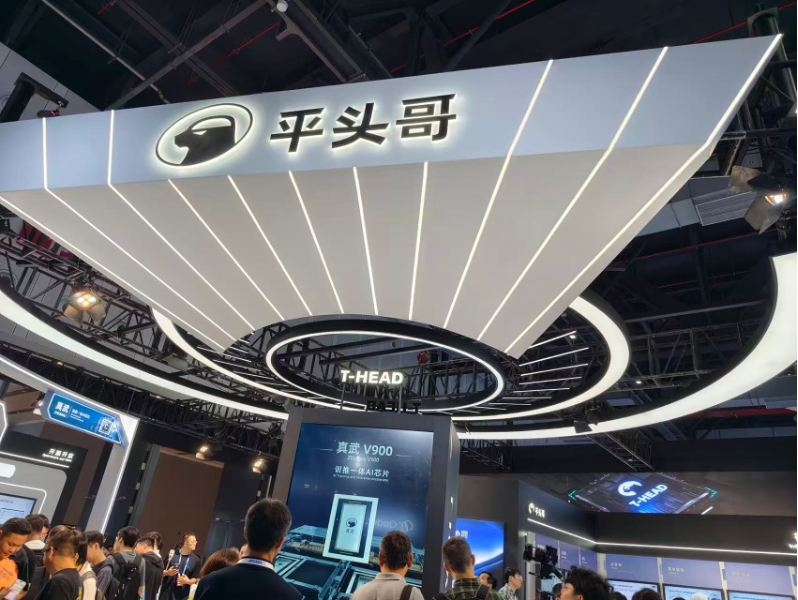
Alibaba has introduced the Zhenwu V900, a new AI training and inference processor designed to strengthen its cloud infrastructure and reduce reliance on Nvidia-class accelerators. The chip was presented at the 2026 Apsara Conference in Hangzhou on September 22. Alibaba says the V900 delivers three times the performance of its predecessor, the Zhenwu M890, and can be deployed in a supernode system designed to scale to as many as 500,000 cards. 1 2
That announcement places Alibaba inside a wider Asian semiconductor contest. Chinese technology companies are trying to secure the hardware, software and data-center capacity needed to run increasingly large models while export controls restrict access to some advanced U.S. processors. The V900 is therefore more than a single product launch. It is a component in Alibaba’s plan to control a larger share of the AI stack, from silicon and networking to models, cloud services and enterprise agents.
What Alibaba announced
The V900 is being positioned for two workloads: training, where a model learns from very large datasets, and inference, where the trained model responds to users or performs tasks. Alibaba Cloud’s official account describes the processor as having 216 GB of GPU memory, 1,200 GB/s of inter-chip bandwidth, and native support for FP8 and FP4 numerical formats. 2
Lower-precision formats can reduce memory use and increase throughput when a model can tolerate the associated trade-offs. That is relevant to both large-language-model inference and the post-training stages used to adapt models for coding, reasoning or specialized enterprise tasks. Memory capacity is equally important because a larger working set can reduce the need to divide a model across many devices.
Alibaba says the V900 will enter mass production and commercial release in the first quarter of 2027. The company has also announced an upgraded supernode design that combines the V900 with an ICN Switch, Panmai SmartNIC and Zhenyue SSD controller. The objective is to make a group of accelerators behave more like one coordinated system, rather than a collection of isolated cards. 2
The company’s headline claim is a cluster of up to 500,000 cards for frontier-model training and inference. That figure should be read as a target for system architecture, not as evidence that such a cluster is already operating at that scale. Alibaba has not published an independent benchmark, a peak FLOPS figure, a manufacturing node, or a power-consumption number for the V900. 1 Those missing values make direct comparisons with Nvidia products difficult.
Why Nvidia remains the reference point
Nvidia’s advantage does not come from GPU silicon alone. It combines accelerators, high-speed interconnects, networking, compilers, libraries, model tools and a large developer ecosystem. A rival chip must therefore perform well inside a complete software and service environment.
Alibaba has a natural advantage in that area because it operates a major cloud platform and develops the Qwen model family. The company can tune its infrastructure for workloads it controls, expose the chips through Alibaba Cloud services, and collect operational data from customers. Its cloud business reported that more than 650 external customers across industries had adopted Zhenwu processors by the time of the Apsara announcement. 2
The earlier Zhenwu M890 provides a useful baseline. Reuters reported in May that the M890 delivered three times the performance of its predecessor, the Zhenwu 810E, and that Alibaba had shipped more than 560,000 Zhenwu units to more than 400 external customers. Reuters also reported that Alibaba had planned the V900 for the third quarter of 2027 before the later schedule moved to early 2027. 3
That cadence suggests a deliberate strategy: improve the processor family, deploy it through the company’s cloud, and use customer demand to justify more capacity. The approach does not require Alibaba to displace Nvidia in every market. It only needs to make domestic and selected international workloads viable on Alibaba-controlled infrastructure.
From a chip launch to a cloud-capacity race
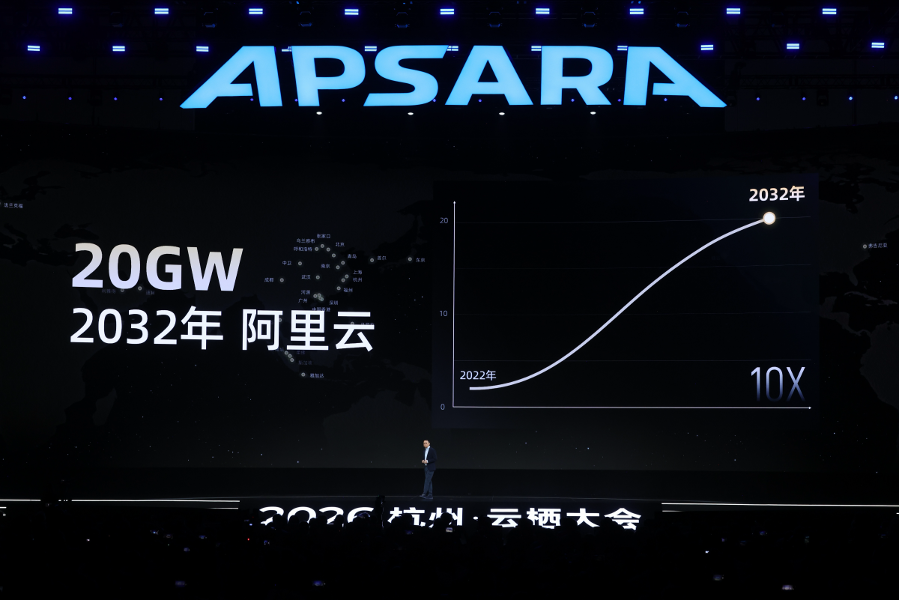
Alibaba’s larger target is to operate more than 20 gigawatts of global data-center capacity by 2032. It has linked that target to the expected growth of AI training, inference and agent-based applications. The company says it will expand its cloud footprint in regions including Türkiye, Finland and the Netherlands, while adding capacity in Malaysia, Germany, the United Arab Emirates, France and Hong Kong. 2
A 20 GW target is not equivalent to useful AI capacity. Data centers need electricity, cooling, networking, storage, land, permits and reliable supply chains. The actual value of the capacity will depend on how much can be allocated to AI workloads, how efficiently the facilities run, and whether the supporting software can keep large clusters busy.
Alibaba itself has acknowledged that shortages across the AI supply chain are limiting the speed at which compute infrastructure can scale. 1 Domestic chip design does not automatically remove those constraints. Advanced packaging, high-bandwidth memory, optical networking, server components and manufacturing capacity remain important bottlenecks.
The V900 still matters within this context because it gives Alibaba a platform around which to organize those dependencies. A company that controls the accelerator, the model stack and the cloud scheduling layer can optimize the whole system instead of waiting for every part of the supply chain to be supplied by external vendors.
The Qwen connection
Alibaba is linking the V900 to a longer Qwen roadmap. Qwen 4 is reportedly in training, while the company’s plans for Qwen 4.5 and Qwen 5 describe models that could reach 5 to 10 trillion parameters. 2 Those figures describe a future design ambition, not a model that is already available or independently evaluated.
Larger parameter counts do not automatically produce better results. Training data, data quality, architecture, routing, memory movement, software efficiency and evaluation methods can matter as much as raw size. Still, model plans at this scale explain why Alibaba is investing in high-capacity memory, fast interconnects and large supernodes.
The company has also described experiments in automated model improvement and chip design. According to Alibaba Cloud, one Qwen model completed 33 iterative cycles over a month, while a chip-design test used more than 10,000 electronic-design-automation tool calls and reduced chip area by 42% without a performance loss. 2 These are company-reported results, so they should be treated as claims awaiting broader technical validation.
A regional contest, not a two-company race
The V900 arrives as Huawei and other Chinese chip developers pursue their own accelerator roadmaps. Tom’s Hardware noted that Huawei’s planned Ascend 960PR was described with 192 GB of memory, 2.4 TB/s of memory bandwidth and a 2.2 TB/s scale-up interconnect. 1 Those specifications are not enough to determine which system will be faster in production, but they show that the contest is becoming more specialized.
Other Asian technology companies are also building internal accelerators or investing in dedicated AI infrastructure. The common motive is resilience: access to computing power has become a strategic business requirement, and dependence on one foreign supplier creates exposure to export rules, supply interruptions and pricing pressure.
For cloud customers, more domestic options could improve availability and give them leverage in procurement. For developers, the result could be a more varied software ecosystem. The drawback is fragmentation. Models and tools may need to be adapted separately for several accelerator families, increasing engineering costs and making performance comparisons harder.
What to watch before 2027
The most important evidence will arrive when the V900 is available for independent testing. Reviewers and customers will need to measure training time, tokens per second, memory efficiency, cluster scaling, failure recovery and total cost per useful output. A three-times claim can mean different things depending on the benchmark, precision, model size and comparison system.
Power efficiency will be especially important. A fast accelerator that consumes substantially more electricity may be less attractive than a slower device with better cost per token. The same is true for software maturity: compiler quality, kernel availability, debugging tools and model portability can determine whether theoretical capacity becomes usable capacity.
Alibaba will also need to demonstrate that its commercial schedule can be met. The company has moved the release window forward, but large-scale production requires stable manufacturing, advanced packaging, memory supply and system integration. The difference between a conference announcement and a dependable cloud service is execution over time.
Closing Thoughts
The Zhenwu V900 should not be judged only by whether it defeats a particular Nvidia GPU on a slide. Its larger significance is that Alibaba is trying to turn AI hardware into a repeatable service: design the processor, connect it to a cloud platform, run the company’s own models, and offer the resulting capacity to businesses.
That strategy can succeed without producing a universal replacement for Nvidia. If the V900 is reliable, affordable and well supported inside Alibaba Cloud, it can reduce the company’s exposure to external supply and give Chinese customers a credible route to large-scale AI. The strongest proof will come from ordinary production workloads, not launch-day claims.
What is the true implication of this?
The true implication is a shift from buying isolated accelerators to building complete, regionally controlled AI-computing systems. Hardware, cloud capacity, model design and software tools are becoming tightly connected. Companies that control several layers can decide how quickly new models move from research into commercial services.
For Asia, that means the AI supply chain may develop along several technology centers rather than around one dominant platform. Such diversity can improve resilience, but it can also create competing standards and raise the cost of moving software between systems.
Why does this make a difference?
It makes a difference because access to compute affects who can train advanced models, offer low-cost inference and deploy AI at scale. Alibaba’s V900 gives the company another instrument for securing that access while supporting its cloud business and Qwen roadmap.
The chip will not settle the global AI competition by itself. Its effect will depend on production, software, electricity, customer adoption and independent performance results. Still, the announcement shows that the next stage of competition is being fought across the full infrastructure stack, not only inside the processor.
References
Comments