


AI Safety Report: Anthropic Leads with C+, OpenAI and Google DeepMind Follow

The rapid advancement of Artificial Intelligence (AI) necessitates rigorous evaluation of its safety and ethical implications. The Future of Life Institute (FLI) plays a crucial role in this by publishing its AI Safety Index, an independent assessment that rates leading AI companies on their efforts to manage both immediate harms and catastrophic risks. The latest edition, the Summer 2026 AI Safety Index, reveals a critical evaluation of nine prominent AI developers, highlighting both progress and persistent shortcomings in the industry's commitment to safety. This report underscores the urgent need for robust safety practices as AI capabilities continue to evolve at an unprecedented pace.
Methodology of the AI Safety Index
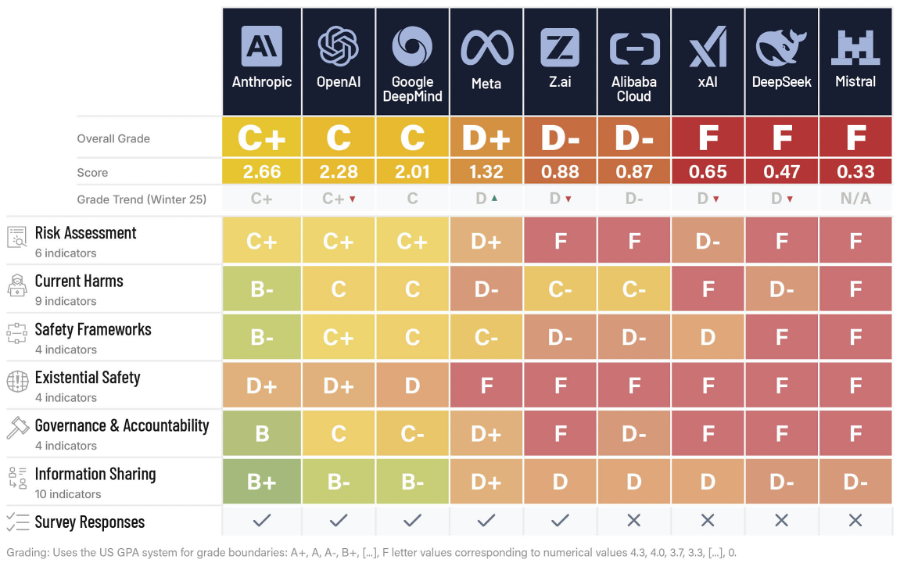
The FLI AI Safety Index employs a comprehensive methodology to assess AI companies, utilizing the US GPA system for grading. Companies are evaluated across 35 indicators spanning six critical domains: Risk Assessment, Current Harms, Safety Frameworks, Existential Safety, Governance & Accountability, and Information Sharing. An independent panel of distinguished AI experts conducts the scoring, ensuring impartiality and deep expertise in the field. This structured approach provides a clear, comparable measure of each company's safety posture, offering valuable insights into areas of strength and weakness.
Key Findings: Company Performance
Anthropic: A Consistent Leader with a C+
Anthropic has consistently demonstrated a stronger commitment to AI safety compared to its peers, earning the highest overall grade of C+ in the Summer 2026 report. This rating reflects its relatively strong transparency and a comparatively established safety framework. Anthropic's performance is particularly notable in several areas:
Risk Assessment: The company received a C+ in this domain, indicating proactive measures in identifying and evaluating potential risks associated with its AI systems.
Information Sharing: With a B+ in information sharing, Anthropic exhibits a commendable level of transparency regarding its technical specifications and engagement with external reporting frameworks.
Governance & Accountability: A B grade in this area suggests robust internal governance structures and a clear commitment to responsible AI development.
Anthropic's leading position is attributed to its efforts in conducting human participant bio-risk trials, excelling in user privacy by not training on user data, and delivering strong safety benchmark performance. Its Public Benefit Corporation structure and proactive risk communication further solidify its standing as a frontrunner in AI safety [1].
OpenAI and Google DeepMind: Room for Improvement with C Grades
OpenAI and Google DeepMind both received an overall grade of C in the Summer 2026 report. While these companies are recognized as top performers alongside Anthropic, their scores indicate significant areas where improvements are needed, particularly when compared to the highest standards of safety and transparency.
OpenAI's performance highlights include:
Risk Assessment: OpenAI also achieved a C+ in risk assessment, demonstrating efforts in evaluating dangerous capabilities.
Information Sharing: A B- in information sharing indicates some level of transparency, though there is scope for further openness.
Governance & Accountability: With a C grade, OpenAI shows a foundational commitment to governance, but could enhance its practices.
OpenAI distinguished itself in previous reports by publishing its whistleblowing policy and outlining a more robust risk management approach. However, the Summer 2026 report suggests a slight decline in its overall grade trend from Winter 2025, moving from C+ to C [2].
Google DeepMind's evaluation shows:
Risk Assessment: Google DeepMind also scored a C+ in risk assessment, aligning with the top performers in this crucial domain.
Information Sharing: A B- in information sharing mirrors OpenAI's performance, indicating similar levels of transparency.
Governance & Accountability: A C- grade points to a need for stronger governance and accountability mechanisms.
Google DeepMind's consistent C grade across reports indicates a steady but not exceptional approach to AI safety. The report notes that while these leaders marginally improved the quality of their model cards, the underlying safety tests still often miss basic risk-assessment standards [2].
Meta and Other Companies: Lagging Behind
Meta received a D+ overall grade in the Summer 2026 report, indicating substantial deficiencies in its AI safety practices. Other companies, including Z.ai, Alibaba Cloud, xAI, DeepSeek, and Mistral, received even lower grades, ranging from D- to F. This wide disparity in scores underscores a significant divide within the AI industry.
Meta's specific grades include:
Risk Assessment: D+
Current Harms: D-
Safety Frameworks: C-
Existential Safety: F
Governance & Accountability: D+
Information Sharing: D+
This data illustrates that many companies are not adequately addressing critical safety concerns, particularly in areas such as existential safety and comprehensive risk assessment. The report emphasizes that while some companies make token efforts, none are doing enough to mitigate the potential risks of advanced AI systems [3].
Critical Observations and Challenges
A clear divide persists between the top performers (Anthropic, OpenAI, and Google DeepMind) and the rest of the companies reviewed. The most substantial gaps exist in risk assessment, safety frameworks, and information sharing, often caused by limited disclosure and weak evidence of systematic safety processes. A particularly alarming finding is that existential safety remains the industry’s core structural weakness. Despite claims of racing toward Artificial General Intelligence (AGI) or superintelligence, none of the reviewed companies scored above D in Existential Safety planning. Professor Stuart Russell of UC Berkeley critically observes, "AI CEOs claim they know how to build superhuman AI, yet none can show how they'll prevent us from losing control – after which humanity's survival is no longer in our hands" [1].
Inadequate Safety Practices Amidst Accelerating Capabilities
Despite public commitments, companies' safety practices continue to fall short of emerging global standards. While many companies partially align with these standards, the depth, specificity, and quality of implementation remain uneven. This results in safety practices that do not yet meet the rigor, measurability, or transparency envisioned by frameworks such as the EU AI Code of Practice. The report also notes that capabilities are accelerating faster than risk-management practices, and the gap between firms is widening. With no common regulatory floor, a few motivated companies adopt stronger controls while others neglect basic safeguards, highlighting the inadequacy of voluntary pledges [2].
Transparency Issues and the Chinese Regulatory Context
Whistleblowing policy transparency remains a weak spot across the industry. Public whistleblowing policies are a common best practice in safety-critical industries, enabling external scrutiny. Yet, among the assessed companies, only OpenAI has published its full policy, and even that occurred after media reports revealed restrictive non-disparagement clauses [2].
The report also acknowledges the unique Chinese regulatory context. It is challenging to provide a fair comparison between frontier AI companies in China and those in the United States due to differing contexts. Chinese companies operate under national and local regulations that carry immediate force, with legal and market-access consequences. This contrasts with the more voluntary commitments often seen in Western companies. Therefore, the relative scarcity of voluntary safety commitments by Chinese companies like Alibaba Cloud and DeepSeek may reflect differences in regulatory expectations rather than a complete lack of safety considerations [3].
Below is a visual representation of the overall grades and domain-specific scores for the companies evaluated in the Summer 2026 AI Safety Index.
For a deeper understanding of the report's implications and expert opinions, you can watch discussions from the Future of Life Institute:
Max Tegmark on the Winter 2025 Results: https://futureoflife.org/ai-safety-index-winter-2025/ (Video available on page)
Max Tegmark on the Summer 2026 Results: https://futureoflife.org/ai-safety-index-summer-2026/ (Video available on page)
The Future of Life Institute's AI Safety Index serves as a vital barometer for the AI industry's commitment to safety. While Anthropic continues to set a higher standard with its C+ rating, the overall picture reveals an industry that is fundamentally unprepared for the profound implications of its own stated goals. The persistent gaps in existential safety planning, the uneven adoption of robust safety practices, and the lack of transparency in critical areas demand immediate and concerted action. As AI capabilities continue to advance, it is imperative for companies, regulators, and the broader public to work collaboratively to ensure that the development of AI prioritizes safety, ethics, and long-term societal well-being. The findings of this report are a call to action, urging a collective effort to steer AI development towards a future that is both innovative and secure.
References
[1] Future of Life Institute. (2026). AI Safety Index — Summer 2026. https://futureoflife.org/ai-safety-index-summer-2026/
[2] Future of Life Institute. (2025). AI Safety Index — Winter 2025. https://futureoflife.org/ai-safety-index-winter-2025/
[3] Future of Life Institute. (2025). AI Safety Index — Summer 2025. https://futureoflife.org/ai-safety-index-summer-2025/
Comments