


AI-Driven Scientific Progress: Advanced Algorithms Solving Decades-Old Mathematical Enigmas

The integration of Artificial Intelligence into the realm of pure mathematics marks a significant turning point in scientific history. For centuries, mathematical discovery was considered a uniquely human endeavor, requiring intuition, creativity, and a deep understanding of abstract structures. However, recent developments in neural networks and reinforcement learning have demonstrated that machines can not only assist humans but also independently solve theoretical problems that have remained unanswered for decades. This shift from AI as a mere computational tool to a creative partner in discovery is reshaping the scientific field.
The IMO Breakthrough: AlphaProof and AlphaGeometry 2
One of the most notable recent achievements occurred in the arena of competitive mathematics. In 2024, Google DeepMind introduced two systems, AlphaProof and AlphaGeometry 2, which successfully solved problems from the International Mathematical Olympiad (IMO) at a level equivalent to a silver medalist. This achievement is particularly noteworthy because IMO problems are designed to test creative reasoning and original thought, rather than routine calculation.
AlphaProof is a reinforcement-learning-based system that trains itself to prove mathematical statements in the formal language of Lean. By bridging the gap between natural language reasoning and formal verification, it can explore mathematical possibilities with a level of rigor that prevents the "hallucinations" often seen in standard large language models. Meanwhile, AlphaGeometry 2 utilizes a neuro-symbolic approach, combining the intuitive pattern recognition of neural networks with the logical precision of symbolic engines.
"The ability of AI to reason through complex geometry and formal proofs at an Olympiad level suggests that we are entering an era where machines can contribute to the very foundation of mathematical logic."
System | Methodology | Achievement |
AlphaProof | Reinforcement Learning + Lean | Solved 4/6 IMO problems in 2024 |
AlphaGeometry 2 | Neuro-symbolic Reasoning | Reached Gold-medal performance in geometry |
FunSearch: LLMs for New Mathematical Discoveries
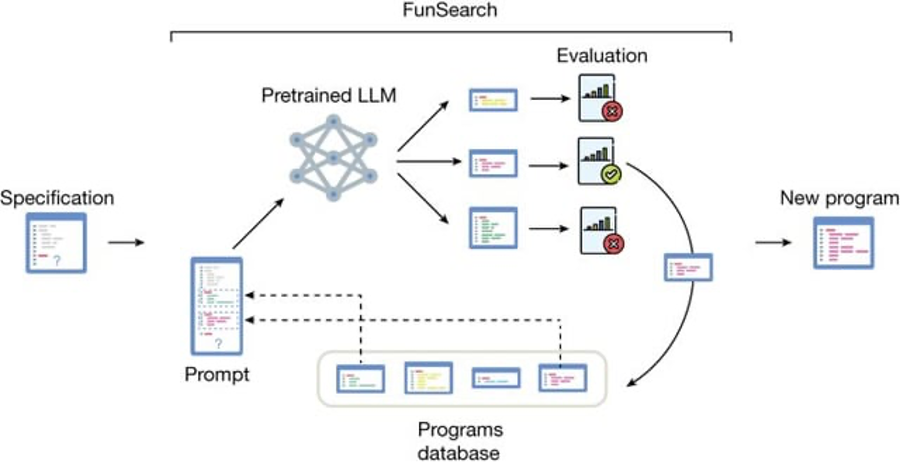
While many AI models are used to verify existing proofs, Google DeepMind’s FunSearch (short for "searching in function space") has taken a step further by discovering new solutions to open problems. FunSearch pairs a pre-trained large language model with an automated evaluator. The model suggests snippets of computer code (functions) to solve a problem, and the evaluator tests them. The best solutions are then fed back into the model to iterate and improve.
This method led to the first discovery in a major open problem using a large language model: finding a new, larger solution for the "cap set problem" in extremal combinatorics. This problem, which involves finding the largest set of points in a grid where no three points form a straight line, had stumped mathematicians for years. FunSearch’s ability to generate human-readable code allowed mathematicians to understand the logic behind the discovery, facilitating further human-led research.
AlphaTensor: Optimizing the Core of Computation
In the field of computer science and linear algebra, the efficiency of matrix multiplication is fundamental to almost all modern technology, from graphics rendering to the training of AI itself. For 50 years, the Strassen algorithm was the standard for fast matrix multiplication, but it was unclear if even faster methods existed.
AlphaTensor, an AI system based on reinforcement learning, treated the search for new algorithms as a game. By playing this "game" millions of times, it discovered algorithms that are more efficient than those previously known to humans. Specifically, it found a way to multiply $4 \times 4$ matrices in 47 multiplications, improving upon the 49 multiplications required by the best human-designed algorithm. This breakthrough does not just solve a theoretical puzzle; it has practical implications for speeding up every piece of software that relies on heavy matrix operations, from large-scale climate simulations to the very neural networks that powered its own discovery.

Untangling Knot Theory with AI
Knot theory, a branch of topology, deals with the mathematical properties of knots. Despite its name, it has profound applications in biology (DNA folding) and physics (quantum field theory). In a collaborative effort between DeepMind and mathematicians from the University of Oxford, AI was used to identify a completely new connection between two different types of mathematical invariants in knots.
The AI acted as a guide, identifying patterns in massive datasets that were too complex for human observation. By highlighting these correlations, it allowed mathematicians to formulate and prove a new theorem, demonstrating how AI can serve as a "mathematical telescope" to see structures that were previously invisible.

Resolving the Erdős Unit Distance Problem
One of the most recent and shocking breakthroughs came in early 2026, when an advanced internal model (widely reported as GPT-5.4 Pro or an equivalent reasoning model) provided a counterexample that disproved a long-standing conjecture by Paul Erdős. The "unit distance problem" asks for the maximum number of pairs of points in a set of $n$ points that can be exactly one unit apart.
For 80 years, mathematicians had worked within a specific range of possibilities. The AI model constructed a complex graph that broke previous bounds, providing a new polynomial improvement that shifted the entire understanding of the problem. This result was so significant that it is currently undergoing peer review for publication in top-tier mathematical journals, marking a landmark in the history of AI-human scientific collaboration.
A New Era of Collaboration
The successes of these algorithms do not imply the obsolescence of human mathematicians. Instead, they point toward a future of augmented intelligence. The technical shift enabling these discoveries lies in the transition from purely statistical models to "reasoning" models that incorporate formal verification. By training on vast repositories of mathematical data and using formal languages like Lean or Isabelle, AI can now self-correct and verify its own logical steps. AI excels at searching vast spaces of possibilities and identifying non-obvious patterns, while humans excel at conceptualizing problems and providing the final rigorous proof.
The removal of the computational burden allows researchers to focus on higher-level theoretical questions. As these tools become more accessible, the pace of mathematical discovery is expected to accelerate, potentially leading to breakthroughs in cryptography, materials science, and our fundamental understanding of the universe.
The transition of AI from a basic calculator to a solver of complex theoretical problems is one of the most profound shifts in modern science. By solving problems like the unit distance conjecture and IMO-level geometry, AI has proven its capability to handle the most abstract and difficult tasks known to the human mind. We are no longer just using computers to calculate; we are using them to think, reason, and discover the hidden laws of mathematics that have eluded us for generations.
Summary of Key References
Videos:
Key Concepts:
Neuro-symbolic AI: Combining neural networks with symbolic logic.
Formal Verification: Using languages like Lean to ensure mathematical truth.
Reinforcement Learning: Treating mathematical discovery as a game to be optimized.
Comments