


AI-Driven Consolidation of Military and Police Hardware

Military and police agencies are moving from isolated experiments with robots and drones toward connected fleets that share sensors, software, mission data and human operators. The change is not simply about buying a robot dog or adding another camera-equipped aircraft. It is about combining ground robots, aerial systems, artificial intelligence, communications and command tools into one operational layer.
Europol’s 2025 report on robotics and unmanned systems describes a broad public-safety shift: agencies are adopting these systems to improve situational awareness, protect personnel and extend operational reach. The same report warns that safety, privacy, data protection, regulation and public trust must develop alongside the technology. 1
From separate machines to coordinated formations
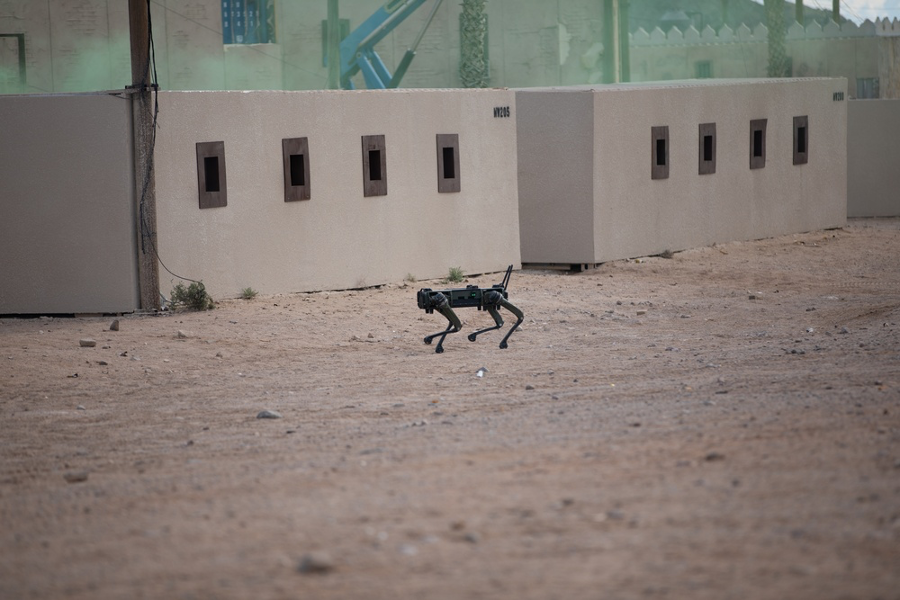
The strongest military example is the U.S. Army’s human-machine integration program. In a January 2025 account, Army authors described a formation that blends soldiers with robotic and autonomous vehicles. The stated principle is not to remove people from operations, but to place machines ahead of them for reconnaissance, mapping, logistics and other dangerous tasks. 2
The experimental platoon combines several types of equipment. A small unmanned ground vehicle can carry supplies or accept modular payloads. A quadruped robot can inspect dead space ahead of troops. Short- and medium-range uncrewed aircraft provide full-motion video, while other systems support mapping or loitering missions. The value comes from the combination: an aircraft can identify an area, a ground robot can approach it, and human personnel can make the final operational decision.
This model also shows why hardware consolidation is becoming a software problem. A force may have several vehicle types, but personnel need a shared control interface, common data links, compatible batteries, secure communications and a way to understand what each system has detected. AI can help classify objects, prioritize alerts and plan routes, yet it cannot remove the need for trained operators who understand context and accountability.
The U.S. Department of Defense’s Replicator initiative adds a production dimension. In December 2024, the department said it was pursuing thousands of autonomous systems across multiple warfighting domains and described the systems as “attritable,” meaning that they are unmanned and affordable enough for commanders to accept more operational risk. The initiative also turned toward counter-drone capabilities, showing that the same expansion of unmanned hardware creates a demand for detection and defense systems. 3
Patrol and high-risk police work
Police agencies are applying a similar logic at a smaller scale. New York City’s Digidog is a remote-controlled quadruped designed for situations such as barricaded suspects and hostage incidents. In 2023, the NYPD also presented an autonomous security robot for a pilot in the Times Square subway station. The devices were presented as tools that could give officers more information while reducing exposure to danger. 4
The New York case also illustrates the public conversation that accompanies these deployments. Critics questioned the cost, appearance and surveillance implications of the machines. A robot that carries cameras and microphones is not only a piece of equipment; in a public space, it becomes part of the relationship between residents and the state. Clear rules about where it can operate, what it records, how long data is stored and who can access it are central to legitimacy.
Patrol robots are most useful when their job is narrow and visible. They may watch a station entrance, relay video from a hazardous room, inspect a suspicious object or carry a loudspeaker. Claims of autonomy should be separated from simple remote operation. A system that follows a preplanned route is not making the same type of decision as a system that identifies a person, predicts behavior or chooses when to intervene.
Bomb disposal and hazardous scenes
Explosive-ordnance disposal remains one of the clearest cases for robotic assistance. The FBI’s Hazardous Devices School uses robots to practice entering through doors, climbing stairs and opening vehicle doors. Its training video explains that sending a robot first can keep a bomb technician away from the initial danger. 5
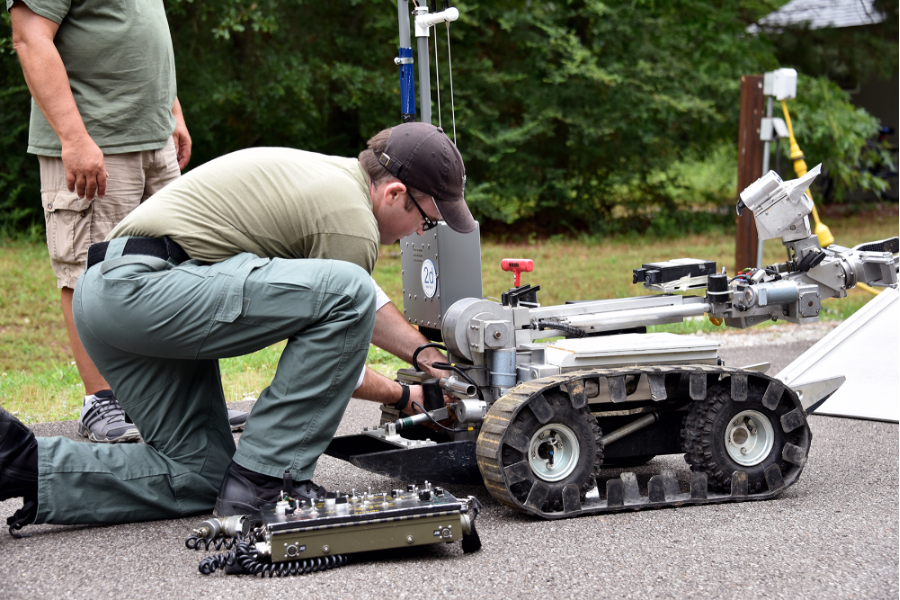
The robot does not need to operate independently to provide major safety benefits. Cameras, lights, manipulator arms and tracked mobility already let specialists inspect and handle objects from a distance. AI can assist by improving image search, highlighting unusual shapes or helping an operator navigate a complex scene. The technician remains responsible for interpreting evidence and deciding how to proceed.
The same principle applies to chemical, biological and radiological incidents. A United Kingdom project tested robots and drones fitted with gas sensors, video, thermal imaging and 2D or 3D mapping tools. The systems were designed to assess contaminated scenes, identify hazards and support police, military and scientific responders without immediately sending people into the most dangerous area. 6
These missions favor a mixed fleet. A small drone can enter a confined space, a ground robot can move across uneven surfaces, and a larger platform can carry sensors or communications equipment. AI helps fuse their observations into a common operational picture. The practical goal is not a machine that understands an entire incident like a human investigator. It is a system that reduces blind spots and shortens the time between detection and informed action.
Why consolidation is accelerating
Several forces are pushing agencies toward integrated hardware.
First, sensors have become smaller, cheaper and easier to mount on commercial platforms. A police department or military unit can add electro-optical cameras, infrared sensors, microphones, chemical detectors or mapping payloads without creating an entirely new vehicle.
Second, software can connect different devices. A drone’s video can be displayed beside a ground robot’s thermal image. A command team can assign a waypoint, request a closer inspection or transfer control between operators. This creates a common operating picture, but it also creates a single point of failure if networks, authentication or cloud services are poorly protected.
Third, agencies are under pressure to reduce exposure to danger. Robots can be sent toward explosives, contaminated buildings, unstable structures or armed suspects before personnel enter. In military settings, unmanned systems can also gather information in places where a human patrol would be easy to detect.
Fourth, procurement is shifting toward adaptable platforms. Instead of purchasing one machine for one mission, agencies increasingly seek systems that accept interchangeable payloads and software updates. That approach can lower long-term costs, but it can also make testing more complicated. A platform that is safe for observation may require a new review when it receives a different sensor, navigation model or intervention tool.
The hard questions: control, bias and failure
Greater autonomy does not eliminate responsibility. It can make responsibility harder to see. When an algorithm prioritizes a target, labels an object or recommends a route, operators need to know what the system observed, how confident it was and what information it did not have.
Training data is another concern. A visual model that performs well in a desert may fail in rain, smoke, crowded streets or low light. A system trained mostly on military imagery may not transfer safely to civilian policing. False positives can waste scarce resources; false negatives can place people in danger.
Cybersecurity is equally important. Connected robots can expose live video, location data, personal information and operational plans. An attacker who interferes with a control link may not need to destroy a vehicle to cause harm. Delayed video, altered coordinates or a blocked emergency stop can be enough.
Public agencies therefore need operating rules that are specific to the device and the mission. Those rules should address human authorization, recording, data retention, maintenance, audit logs, incident review and public disclosure. The more a system can identify, track or affect people, the stronger the oversight should be.
Closing Thoughts
AI-driven consolidation is turning military and police technology into a networked service rather than a collection of individual machines. The most credible near-term use is not a fully independent robot officer or an unsupervised battlefield machine. It is a human-led team supported by platforms that can see farther, enter first, carry sensors, map a site and keep people away from immediate hazards.
The central test will be disciplined integration. Agencies should evaluate the whole chain: the sensor, the algorithm, the operator, the communications link, the maintenance team and the legal authority behind the mission. A machine can improve safety only when the surrounding system is reliable and accountable.
What does this look like in practice?
A possible incident begins with a report of a suspicious package near a transit station. A patrol drone provides an overhead view while a ground robot approaches with a camera and manipulator arm. AI highlights the object and tracks changes in the scene, but a certified bomb technician controls the inspection. The station’s security robot can redirect pedestrians, while a command system records who authorized each action. If the robot loses its link, it stops or returns to a predefined safe state.
In a military training area, the sequence may involve a small aircraft mapping a route, a quadruped checking a doorway and a transport robot carrying equipment. Soldiers review the data, decide whether the route is safe and choose whether to advance. Each platform contributes a capability; none replaces the chain of command.
How does this impact us?
For the public, the benefits can include fewer responders exposed to explosives, toxic substances and armed confrontations. Faster mapping can also improve emergency response after fires, industrial accidents or natural disasters.
The costs are less visible but just as important. More cameras and autonomous patrols can expand monitoring in public spaces. Data may be copied, retained or shared beyond what residents expect. Mistaken identification can affect innocent people, while opaque procurement can make it difficult to challenge a system after deployment.
Citizens should ask practical questions: Is the device remote-controlled or autonomous? What sensors does it carry? Does it recognize people or only objects? Who can activate it? Where is the data stored? How long is it kept? What independent body reviews misuse or errors?
The answer should not be a blanket rejection of robotics. It should be a demand for proportionate use, visible safeguards and human accountability. The hardware may become more capable, but public trust will depend on the rules surrounding it.
Reference images and videos
Video: FBI — Training with Bomb Disposal Robots, 360-degree video.
Video: Army units practice urban combat with robots — third-party field coverage related to the Army’s human-machine integration experiments.
References
Comments